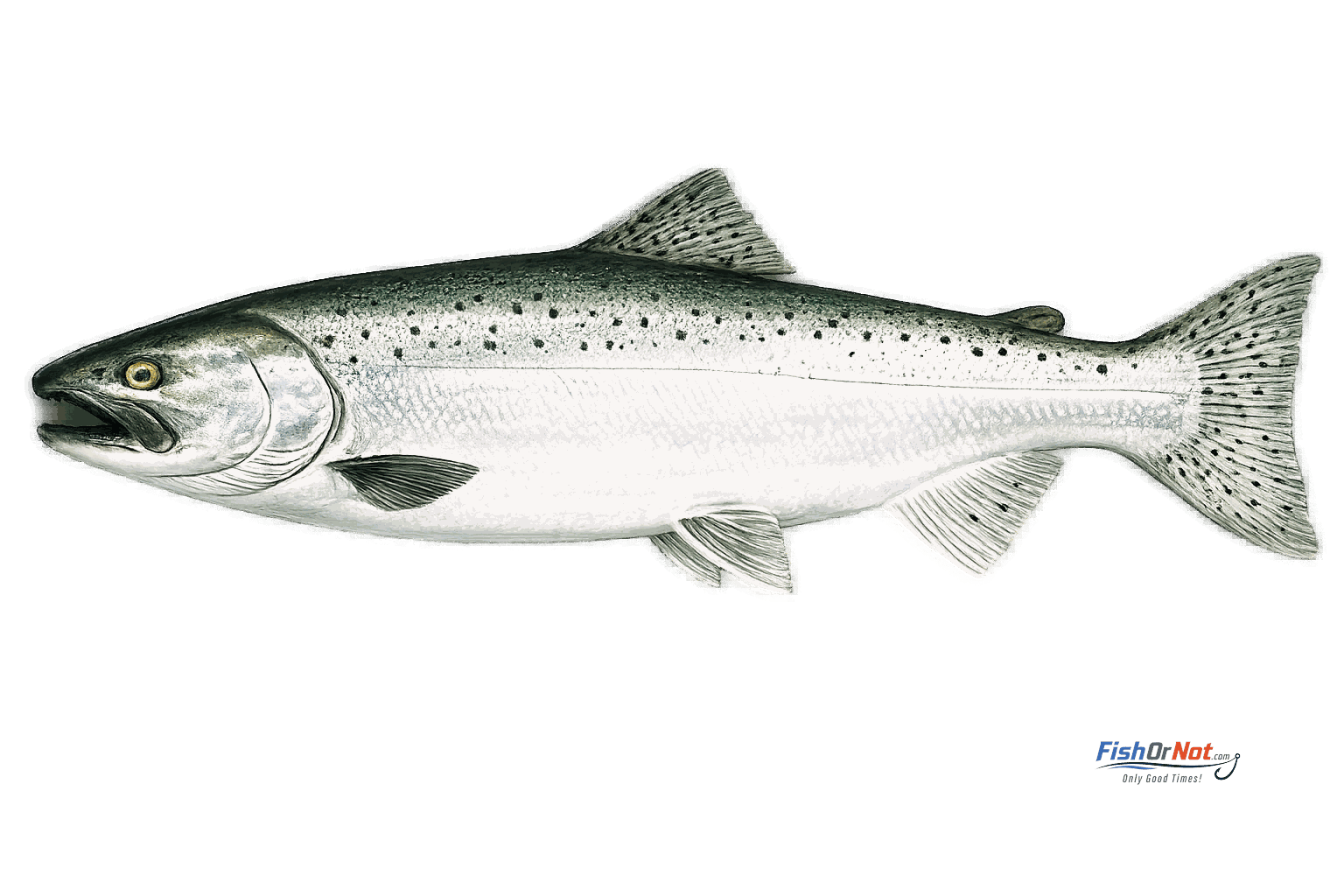
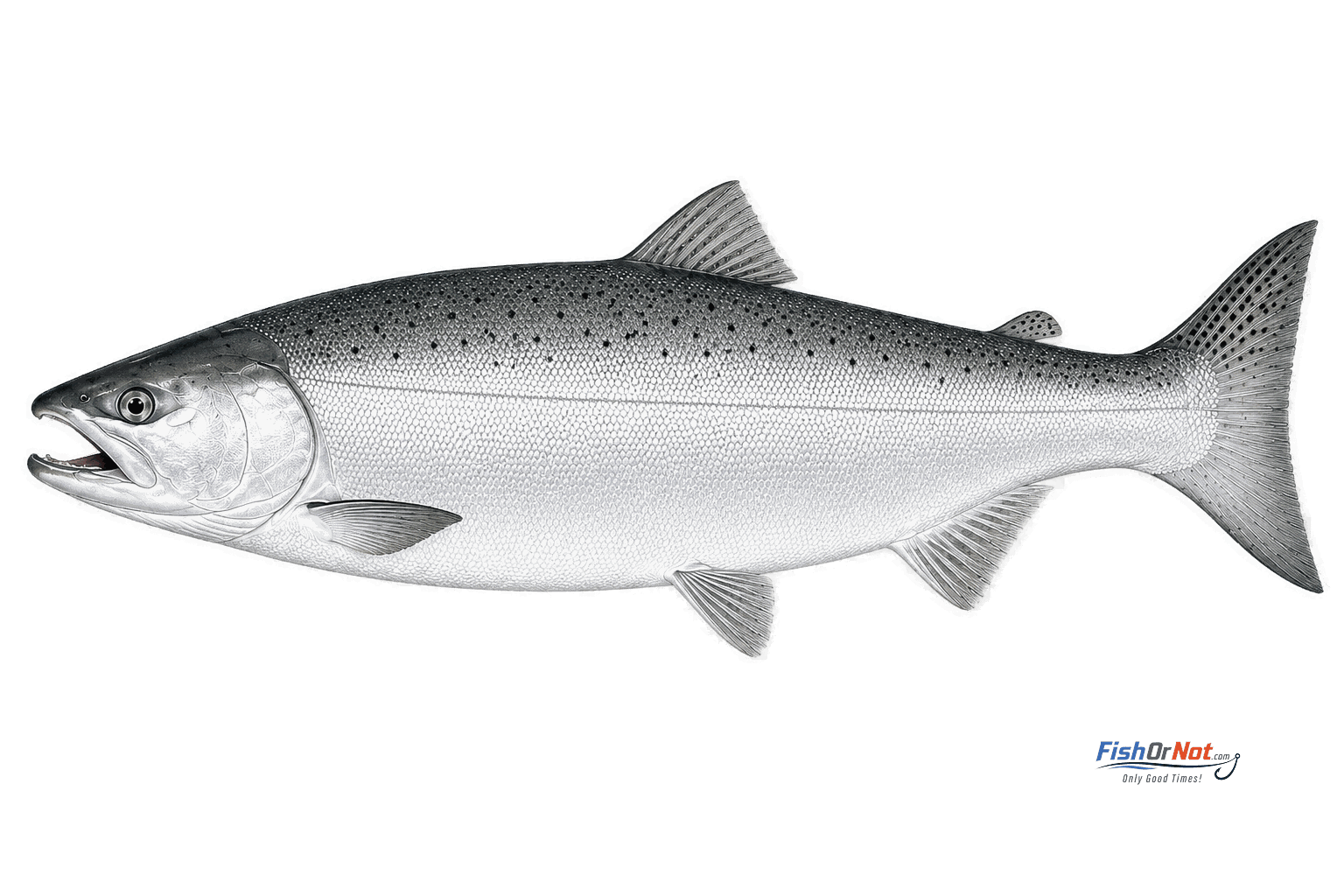
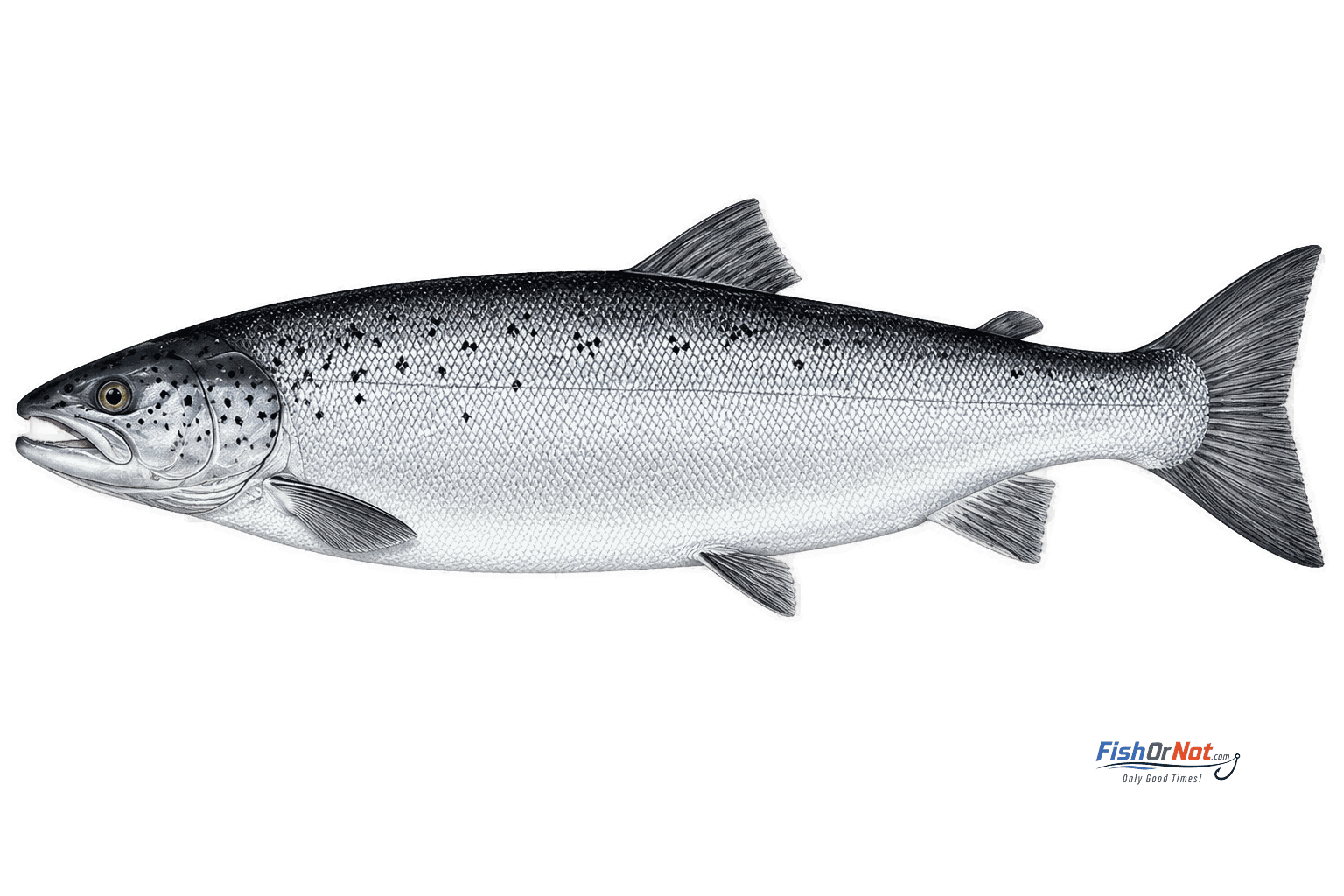
Natural/dark in murky water, silver/blue/chartreuse in clear; glow finishes at night
Retrieve Speed
Trolling: 2–3 mph with flasher. River: drift or back-troll with controlled speed.
Movement Pattern
Consistent trolling depth critical. In rivers: dead drift or back-troll through pools.
Gear
Medium-heavy trolling rod 8–10 ft, 20–30 lb braid, downrigger for depth.
📍 Where to Find Them
Habitat Zone
Open water / Pelagic (lake); River current (spawning)
Depth Range
30–90 m / 100–300 ft in summer; surface in fall rivers
Structure
Thermocline breaks, river mouths, staging pools below falls
🏆 The Verdict
Fight Rating
★★★★★ 5/5 — Explosive runs, powerful head shakes, will sound deep
Eating Quality
Excellent table fish. Rich, fatty flesh. Best smoked, grilled or baked.
Size Range
4–40 kg · 9–88 lb
World Record
57.3 kg / 126 lb (Kenai River, Alaska 1985)
🕐 When They Bite
Active Time
Dawn, Dusk, Night
Best Season
Fall (Sep–Oct peak)
Water Temp
8–14°C / 46–57°F
Weather Sensitivity
Feeds aggressively before pressure drops; active in light rain
Water Clarity
Natural/dark colours in murky, silver/blue in clear
📊 Biology & Behaviour
Feeding Type
Mid-water / Pelagic
Spawning
Sep–Nov (fall run)
Activity Pattern
Crepuscular — most active dawn and dusk; night feeding in rivers
Schooling
Schooling — large aggregations at river mouths during staging
Predator / Prey
Eats: alewife, smelt, herring, small fish. Eaten by: orca, sea lion, bears (rivers), lake trout
♻ Catch & Release Notes
Handle quickly in cold water. Barbless hooks mandatory in many rivers. Never remove from water for photos — support body horizontally.
⚖ Typical Bag & Size Limits
Strict limits and closures on most Pacific rivers. C&R only on many BC and AK streams.
⚠ Always check local laws — regulations vary by jurisdiction and change annually.
Pacific coast of North America — Alaska to California. Major river systems: Yukon, Fraser, Columbia, Sacramento. Introduced in Great Lakes (1960s) with self-sustaining populations.
Bright/colourful in peat/dark water; sparse natural in low clear water
Retrieve Speed
Swing flies across current at natural speed; dead drift nymphs in pools
Movement Pattern
Classic wet fly swing. Hitched tube flies create wake on surface.
Gear
14–15 ft double-handed Spey rod, floating or sinking line, fluorocarbon leader.
📍 Where to Find Them
Habitat Zone
Deep river pools, lies behind boulders and current breaks
Depth Range
1–6 m / 3–20 ft in rivers
Structure
Long pools with gravel tails, well-oxygenated riffles, boulder gardens
🏆 The Verdict
Fight Rating
★★★★★ 5/5 — Spectacular jumper, long powerful runs, unpredictable; considered the pinnacle of fly fishing
Eating Quality
Excellent. Rich pink flesh. Many rivers require C&R.
Size Range
2–35 kg · 4–77 lb
World Record
35.9 kg / 79 lb 2 oz (Tana River, Norway 1928)
🕐 When They Bite
Active Time
Dawn, Dusk
Best Season
Summer–Fall
Water Temp
6–14°C / 43–57°F
Weather Sensitivity
Water height and temperature drive activity; peak on rising water after rain
Water Clarity
Bright flies in peat-stained water; low-water subtle patterns in clear
📊 Biology & Behaviour
Feeding Type
Mid-water / Pelagic
Spawning
Oct–Dec (rocky rivers)
Activity Pattern
Crepuscular; responds to water temperature and height
Schooling
Loose river groupings in pools
Predator / Prey
Eats insects and small fish as parr; does not feed in river as adult. Eaten by: seals, porpoise, bears
♻ Catch & Release Notes
Mandatory C&R on many rivers. Never remove from water. Barbless hooks strongly recommended. Revive fully before release — can take several minutes.
⚖ Typical Bag & Size Limits
Strictly regulated — many managed rivers are catch-and-release or hatchery-fish only, and some are closed entirely. Check current regulations.
⚠ Always check local laws — regulations vary by jurisdiction and change annually.
⚠ Species at Risk in many river systems
North Atlantic rivers from Quebec and New Brunswick south to Connecticut; also Iceland, Norway, UK, Russia. Severely depleted — landlocked strains (Ouananiche) persist in Quebec lakes.
Rainbow Trout / Steelhead
Oncorhynchus mykiss
AnadromousFreshwater & Saltwater
▼
🎣 How to Catch Them
Baits & Lures — Best / Medium / Poor
Spawn bagsDrift flies/nymphsSpinnersSpoonsBeadsJigging spoons in lakesLarge plugsBottom sinker rigs (in fast rivers)Scented plastics (ineffective vs salmon eggs)
Optimal Lure Colour
Chartreuse/pink in stained; natural olive/brown in clear; black at night
Retrieve Speed
Dead drift in rivers; slow trolling in lakes; swung fly at current speed
Movement Pattern
River: dead drift with mending. Lake: slow figure-8 near thermocline.
Gear
8–9.5 ft medium-fast rod, 8–12 lb fluorocarbon; Spey 12–13 ft for rivers.
📍 Where to Find Them
Habitat Zone
Rivers: runs, riffles, tailouts; Lakes: near inflows, thermocline
Depth Range
0–6 m / 0–20 ft in rivers; 5–20 m in lakes summer
Structure
Gravel tailouts, river mouths, rocky points in lakes
🏆 The Verdict
Fight Rating
★★★★★ 5/5 — Aerial acrobatics, screaming runs; steelhead considered the most spectacular river fighter
Keep in water at all times. Revive in current. Avoid in warm water above 20°C.
⚖ Typical Bag & Size Limits
Varies widely — often C&R for wild steelhead, harvest allowed for hatchery-marked fish.
⚠ Always check local laws — regulations vary by jurisdiction and change annually.
Pacific slope of North America — Alaska to Mexico. Widely stocked globally. Great Lakes steelhead now self-sustaining in many tributaries including Ontario's Credit and Nottawasaga rivers.
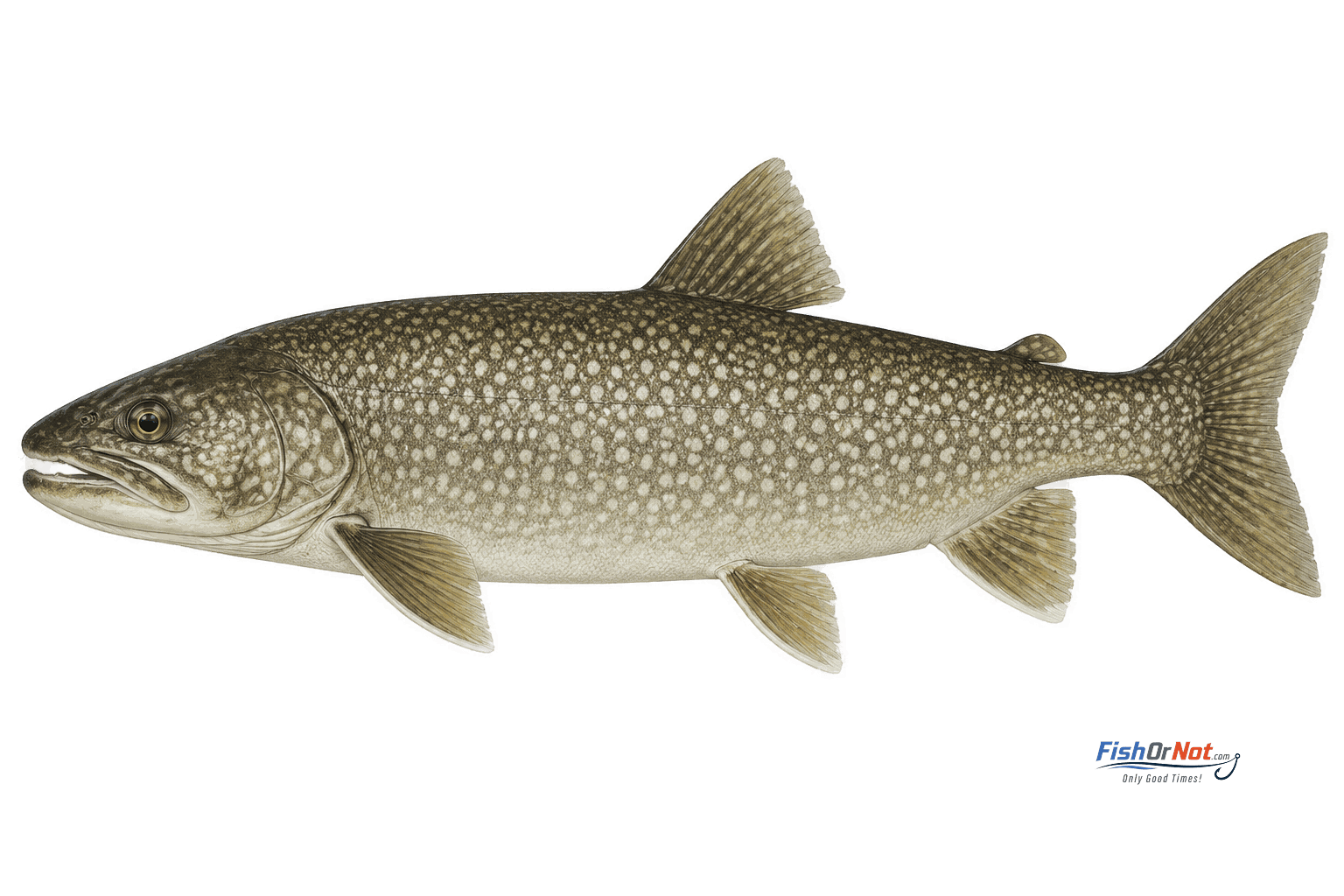
Lake Trout
Salvelinus namaycush
Freshwater
▼
🎣 How to Catch Them
Baits & Lures — Best / Medium / Poor
Tube jigs (large)Spoons (trolling)Jigging spoons at depthSwimbaitsLarge spinnersCisco/sucker live baitSmall luresWormsSurface presentations
Optimal Lure Colour
Silver/white in clear; glow finishes for deep; chartreuse in stained
Retrieve Speed
Trolling: 1.5–2.5 mph. Jigging: vertical lift 30–60 cm at depth.
Movement Pattern
Slow vertical jigging near bottom at depth. Trolling with dipsy diver or downrigger.
Gear
Medium-heavy rod 7–8 ft, 17–25 lb braid, wire or heavy fluoro leader for large fish.
📍 Where to Find Them
Habitat Zone
Deepwater basins; rocky shoals in spring/fall; thermocline in summer
Depth Range
0–90 m / 0–300 ft depending on season
Structure
Rocky points, underwater humps, deep basin near structure
🏆 The Verdict
Fight Rating
★★★☆☆ 3/5 — Strong deep resistance; not acrobatic — power fish, bulldogging
Stable cold conditions preferred; storms push fish shallow
Water Clarity
Natural/silver in clear cold water
📊 Biology & Behaviour
Feeding Type
Mid-water / Pelagic ambush predator
Spawning
Oct–Nov (rocky shoals)
Activity Pattern
Crepuscular; deep in summer heat
Schooling
Loosely schooling on structure
Predator / Prey
Eats: cisco, smelt, whitefish, perch. Eaten by: humans (top predator in most lakes)
♻ Catch & Release Notes
Barotrauma common at depth — use descender tool to release at depth or puncture swim bladder with fine needle if needed. Do not keep at surface.
⚖ Typical Bag & Size Limits
Conservative limits across most of range. Some shield lakes catch-and-release only.
⚠ Always check local laws — regulations vary by jurisdiction and change annually.
Northern North America — Great Lakes, Labrador, Yukon, Great Bear/Slave/Athabasca lakes, and hundreds of Canadian Shield lakes. Requires cold, well-oxygenated water; sensitive to eutrophication.
Strongly nocturnal for large specimens; night fishing often most productive
Schooling
Solitary and territorial; larger fish hold the best lies
Predator / Prey
Eats: insects, worms, crayfish, small fish, mice (at night). Eaten by: otters, herons, osprey, larger fish
♻ Catch & Release Notes
Extremely stress-sensitive in warm water. Do not fish or handle when water above 18°C. Quick release essential.
⚖ Typical Bag & Size Limits
Often slot limits or C&R on trophy streams.
⚠ Always check local laws — regulations vary by jurisdiction and change annually.
Native to Europe and western Asia from Iceland to Aral Sea. Introduced on every continent except Antarctica. Considered invasive in Australia, New Zealand and Patagonia where it competes with native char.
Found in:Lake Ontario
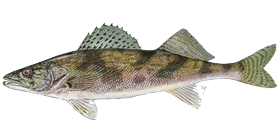
Walleye
Sander vitreus
Freshwater
▼
🎣 How to Catch Them
Baits & Lures — Best / Medium / Poor
Live minnows (nightcrawler rig)Jig & plastic (glow/chartreuse)Bottom bouncer & spinnerCrankbaits (slow roll near bottom)Jigging spoonsWorm harness (trolling)Surface luresFast presentationsLarge swimbaits
Optimal Lure Colour
Chartreuse/white in stained water; natural perch colours in clear; glow finishes at night
Retrieve Speed
Slow drag along bottom with occasional lift-drop. Match speed to water temperature — slower in cold.
Movement Pattern
Lift-drop on jig with 15–30 cm stroke; pause on fall. Bottom bouncer: slow troll 0.8–1.5 mph.
Gear
Medium rod 6–7 ft, 8–14 lb mono or fluorocarbon, spinning or baitcast reel.
📍 Where to Find Them
Habitat Zone
Mid-depth open water; rocky/gravel transition zones; river eddies
Depth Range
3–15 m / 10–50 ft; shallower at night and in spring
Structure
Rock-to-sand transitions, gravel flats, submerged points, river current breaks
🏆 The Verdict
Fight Rating
★★★☆☆ 3/5 — Strong steady resistance; not acrobatic but reliable fighter
Eating Quality
Outstanding — widely considered the finest eating freshwater fish in North America. White, flaky, mild flesh.
Size Range
0.5–10 kg · 1–22 lb
World Record
11.3 kg / 25 lb (Greer Ferry Lake, Arkansas 1982)
🕐 When They Bite
Active Time
Dusk, Night, Overcast
Best Season
Spring & Fall
Water Temp
12–18°C / 54–64°F
Weather Sensitivity
Overcast days dramatically improve daytime fishing. Feeds aggressively before fronts. Drops deep post-front.
Water Clarity
Thrives in stained/murky water; highly light-sensitive tapetum lucidum gives advantage in low light
📊 Biology & Behaviour
Feeding Type
Mid-water / Bottom
Spawning
Mar–May (rocky shoals, river rapids)
Activity Pattern
Strongly nocturnal; peak feeding 1h before sunset to 2h after sunrise
Schooling
Schooling — travels in loose schools by size class
Hardy species. Standard handling. Avoid excessive air exposure. Release in deep water vs. shallow warm areas.
⚖ Typical Bag & Size Limits
Slot limits and daily bag limits apply and vary widely by province and state. Check current regulations.
⚠ Always check local laws — regulations vary by jurisdiction and change annually.
Native to Canada and northern US — Great Lakes, St. Lawrence, Hudson Bay drainages, Missouri, Mississippi. Most widely distributed game fish in Canada.
Found in:Lake OntarioLake Erie
Smallmouth Bass
Micropterus dolomieu
FreshwaterInvasive in parts
▼
🎣 How to Catch Them
Baits & Lures — Best / Medium / Poor
Tube jigsDrop shot (goby imitation)Crayfish imitationsTopwater poppers (early morning)Ned rigHeavy bottom rigsSlow presentations in warm water
Optimal Lure Colour
Green/brown natural in clear water; chartreuse in stained; white/silver for baitfish imitation
Retrieve Speed
Slow crawl on bottom for crayfish imitation; hop-pause-hop. Drop shot: slight shake in place.
Movement Pattern
Crayfish: drag and pause along rocky bottom. Baitfish: erratic darting with direction changes.
Gear
Medium spinning 6.5–7 ft, 8–12 lb fluorocarbon, or light baitcast with 10–14 lb.
📍 Where to Find Them
Habitat Zone
Rocky shorelines, points, and reefs; clear-water lakes; fast river riffles
Resilient but avoid lip-holding heavy fish vertically. Support body. Quick release.
⚖ Typical Bag & Size Limits
Size and slot limits common in Ontario and many US states.
⚠ Always check local laws — regulations vary by jurisdiction and change annually.
Native to eastern North America — St. Lawrence, Great Lakes, upper Mississippi, Ohio River drainages. Now found across entire US and Canada. Considered invasive in many western Canadian and US streams.
Found in:Lake OntarioOttawa River
Largemouth Bass
Micropterus salmoides
FreshwaterInvasive in parts
▼
🎣 How to Catch Them
Baits & Lures — Best / Medium / Poor
Plastic worms (Texas/wacky rig)Topwater frogsJig & crawCrankbaits (shallow)ChatterbaitsSwimbaitsSmall finesse presentationsDeep jiggingFast spinnerbaits in cold water
Optimal Lure Colour
White/chartreuse in stained water; green pumpkin/watermelon in clear; black at night
Retrieve Speed
Slow roll through weeds; topwater: walk-the-dog or pop; flip and pitch to cover.
Movement Pattern
Punch through floating mats. Frog walk on lily pads. Flip jigs to dock pilings.
Gear
Medium-heavy baitcast 7 ft, 17–20 lb mono/fluoro or 50–65 lb braid for heavy cover.
Can be lip-gripped safely. Avoid in extreme heat (water above 28°C). Keep out of air minimal.
⚖ Typical Bag & Size Limits
Daily bag and size limits apply and vary widely by jurisdiction. Check current regulations.
⚠ Always check local laws — regulations vary by jurisdiction and change annually.
Native to eastern and central US — Great Lakes south to Florida, Mississippi drainage. Most widely distributed bass globally. Stocked across Canada, Europe, Japan, South Africa, South America.
Bright orange/red in stained; natural white/perch in clear; chartreuse year-round
Retrieve Speed
Medium-fast with erratic pauses. Topwater: walk fast with brief pauses.
Movement Pattern
Erratic stop-start. Spinnerbaits: steady with speed bursts. Jerkbaits: hard rips with long pauses.
Gear
Medium-heavy 7–7.5 ft spinning or baitcast, 30–50 lb braid, 10–12 in wire or heavy fluoro leader mandatory.
📍 Where to Find Them
Habitat Zone
Weed edges, bays, river backwaters, shallow points
Depth Range
0–7 m / 0–23 ft; deeper in summer
Structure
Cabbage weed edges, mixed rock-weed, bay mouths, river mouth flats
🏆 The Verdict
Fight Rating
★★★★☆ 4/5 — Explosive initial strike, bulldogging runs, head-shaking — ferocious fighter especially in cold water
Eating Quality
Good but bony (Y-bones require skill to fillet). Very good when handled properly. Excellent smoked.
Size Range
0.5–25 kg · 1–55 lb
World Record
25 kg / 55 lb 1 oz (Lake of Grefeern, Germany 1986)
🕐 When They Bite
Active Time
Dawn, Dusk, Overcast
Best Season
Spring & Fall (aggressive); winter ice fishing
Water Temp
10–20°C / 50–68°F
Weather Sensitivity
Highly active in low-pressure overcast conditions; can slow dramatically in high pressure.
Water Clarity
Bright flashy lures in stained; natural coloured in clear
📊 Biology & Behaviour
Feeding Type
Top / Mid-water ambush predator
Spawning
Mar–Apr (flooded vegetation, very early)
Activity Pattern
Crepuscular with notable midday activity when water is cool
Schooling
Solitary ambush predator
Predator / Prey
Eats: perch, bass, ducks, frogs, small mammals, other pike. Eaten by: muskellunge (juveniles); humans
♻ Catch & Release Notes
Wire jaw spreader and long needle-nose essential — teeth are serious. Keep in water. Revive before release. Gill-hook injuries common with trebles — use single or barbless hooks where possible.
⚖ Typical Bag & Size Limits
Generally liberal limits outside trophy-managed waters, where size minimums and stricter rules apply. Check current regulations.
⚠ Always check local laws — regulations vary by jurisdiction and change annually.
Circumpolar freshwater — across North America, Europe, and northern Asia. Most widely distributed freshwater predator on earth. Native throughout Canada.
Found in:Lake Ontario
Muskellunge
Esox masquinongy
Freshwater
▼
🎣 How to Catch Them
Baits & Lures — Best / Medium / Poor
Large figure-8 bucktailsBig swimbaits (20–30cm)JerkbaitsTopwater glidersLive suckersSmall lures under 15cmSlow-moving bottom baits
Optimal Lure Colour
Natural/white in clear water; chartreuse/orange in stained; black at dusk and night
Retrieve Speed
Fast aggressive burn for bucktails. Jerkbait: hard twitches with pauses. Always figure-8 at boat.
Movement Pattern
Figure-8 at boatside mandatory on every single cast — a significant percentage of strikes occur here.
Gear
Heavy 7.5–9 ft baitcast rod, 65–80 lb braid, 100 lb fluorocarbon or wire leader, high-capacity reel.
📍 Where to Find Them
Habitat Zone
Weed edges, open basin near structure, rocky points in fall
Depth Range
1–10 m / 3–33 ft; moves deeper in summer
Structure
Cabbage weed edges, rock-to-weed transitions, deep basin points, large bay structures
Good but most anglers release. Population density is very low — removal of large fish significantly impacts fishery.
Size Range
2–30 kg · 4–66 lb
World Record
31.8 kg / 70 lb (Lake Court Oreilles, Wisconsin 1949)
🕐 When They Bite
Active Time
Dusk, Low light, Overcast
Best Season
Fall (Oct–Nov peak — cooling water triggers aggression)
Water Temp
13–20°C / 55–68°F
Weather Sensitivity
Dramatically more active in cloudy, windy, low-pressure conditions. Stable highs slow them.
Water Clarity
Natural/white in clear; chartreuse/orange in stained; dark patterns at night
📊 Biology & Behaviour
Feeding Type
Top / Mid-water ambush predator (apex)
Spawning
Apr–May (shallow weedy bays)
Activity Pattern
Crepuscular; night fishing effective with topwater in summer
Schooling
Solitary apex predator; each fish holds individual territory
Predator / Prey
Eats: large walleye, pike, bass, ducks, muskrats, carp. Eaten by: nothing (apex) — occasional osprey on juveniles
♻ Catch & Release Notes
Deeply embedded hooks require jaw spreader and long needle-nose pliers. Keep in water. Large muskie can take 10+ minutes to fully revive — hold until actively swims away. Never lift vertically by jaw.
⚖ Typical Bag & Size Limits
Strict slot and season limits throughout range.
⚠ Always check local laws — regulations vary by jurisdiction and change annually.
North American endemic — St. Lawrence, Great Lakes, upper Mississippi and Ohio drainages. Widely stocked in Ontario and many US states as a trophy species.
Resilient. Avoid spines (pectoral and dorsal) — can cause painful wounds. Hold from behind spines or use lip gripper.
⚖ Typical Bag & Size Limits
Generally liberal daily limits across most states, with size limits uncommon. Check current regulations.
⚠ Always check local laws — regulations vary by jurisdiction and change annually.
Native to central North America from southern Manitoba to Gulf Coast and Atlantic slope. Most widely distributed catfish in North America. Widely stocked.
Striped Bass
Morone saxatilis
AnadromousFreshwater & Saltwater
▼
🎣 How to Catch Them
Baits & Lures — Best / Medium / Poor
Live bunker (menhaden)Large white/chartreuse bucktailsSwim shadsClams (surf)Eels (night)Metal lipped swimmersSmall lures under 10cmBottom-only presentations without scentSlow static soft plastics
Optimal Lure Colour
White/chartreuse most versatile; bunker-imitation patterns; dark colours at night
Retrieve Speed
Medium-fast with erratic pauses for plugs. Slow jig for deep fish. Fast for surface blitzes.
Movement Pattern
Work rips and current seams. Cast into feeding blitzes. Swim plugs through structure.
Gear
Heavy 9–11 ft surf rod or 7–8 ft boat rod, 20–50 lb braid, 30–60 lb fluoro leader.
📍 Where to Find Them
Habitat Zone
Coastal surf zone, river mouths, bays, inlets, rips, tidal creeks
Depth Range
0–15 m / 0–50 ft; surface to mid-water during feeding
Structure
Rips, current seams, boulders, jetties, river mouths, sandbars
🏆 The Verdict
Fight Rating
★★★★☆ 4/5 — Powerful sustained runs, strong head shakes — big fish (20+ kg) are endurance battles
Eating Quality
Very good. White flaky flesh. Smaller (slot) fish best eating. Large fish released by most serious anglers.
Size Range
0.5–40 kg · 1–88 lb
World Record
35.6 kg / 78 lb 8 oz (Westfield, Massachusetts 2011 — from shore)
🕐 When They Bite
Active Time
Dawn, Dusk, Night, Moving tide
Best Season
Spring & Fall (migrations)
Water Temp
12–22°C / 54–72°F
Weather Sensitivity
Feeding intensifies on dropping barometer. Surf fishing best in swell/chop.
Water Clarity
White/chartreuse in murky surf; natural/white in clear; topwater at low light
Support large fish horizontally. Avoid exhausting. Barbless circle hooks reduce deep hooking. Slot limits mandatory — check local rules.
⚖ Typical Bag & Size Limits
Strictly regulated on the Atlantic coast with slot and daily limits that are reviewed and changed regularly. Check current regulations.
⚠ Always check local laws — regulations vary by jurisdiction and change annually.
Atlantic coast of North America from Gulf of St. Lawrence to Gulf of Mexico. Major spawning rivers: Hudson, Delaware, Chesapeake tributaries. Introduced Pacific coast (stripers in San Francisco Bay) and landlocked populations in reservoirs.
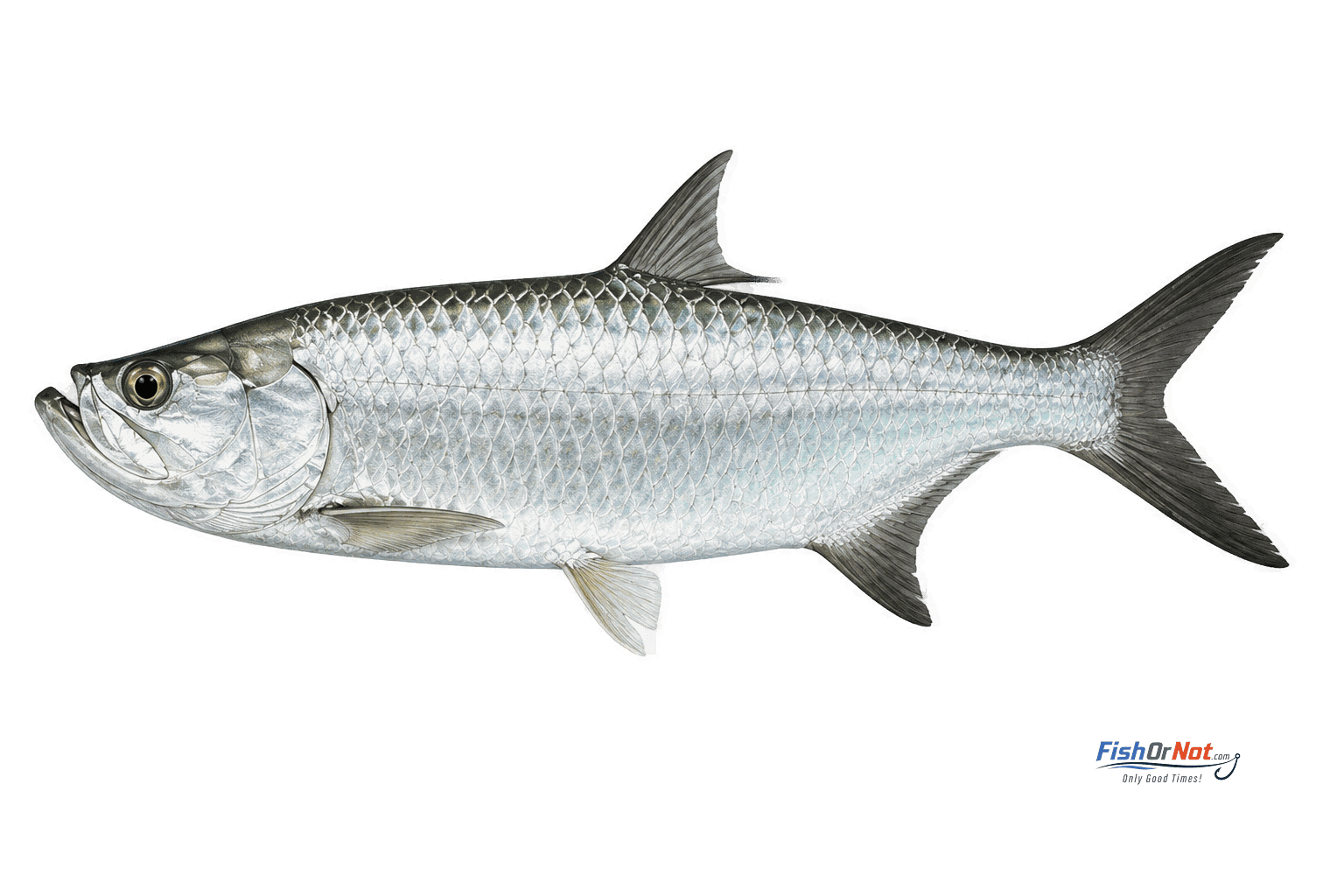
Tarpon
Megalops atlanticus
Saltwater
▼
🎣 How to Catch Them
Baits & Lures — Best / Medium / Poor
Live mullet/crabsFly patterns (EP baitfish, tarpon toads)Slow-sinking swimbaitsCut bait under bridge lightsSoft plastics (slow)Live threadfin herringFast luresBottom rigsSmall lures under 10cm
Optimal Lure Colour
Natural/white/tan on flats in clear; black/purple at night
Retrieve Speed
Slow strip-strip-pause for fly. Slow to medium for live/cut bait. Very slow for nervous fish.
Movement Pattern
Lead the fish — cast 3–4 feet ahead on an intercept course. Strip to generate interest; pause to trigger strike.
Gear
12 wt fly rod, floating line; or heavy spinning 7.5 ft, 50–80 lb braid, 60–100 lb fluoro leader.
Mandatory C&R in most jurisdictions. Revive completely before release — can take 10–20 minutes for large fish. Never lift out of water. Sharks are a constant threat during fights — cut line early if shark is present.
⚖ Typical Bag & Size Limits
C&R only in most of range. Tag-and-release program in Florida. Single tarpon tag available for record attempts only.
⚠ Always check local laws — regulations vary by jurisdiction and change annually.
Atlantic Ocean tropical and subtropical coasts — Florida through Caribbean, Gulf of Mexico, south to Brazil. Seasonally migrates north to North Carolina and beyond. Can tolerate some freshwater.
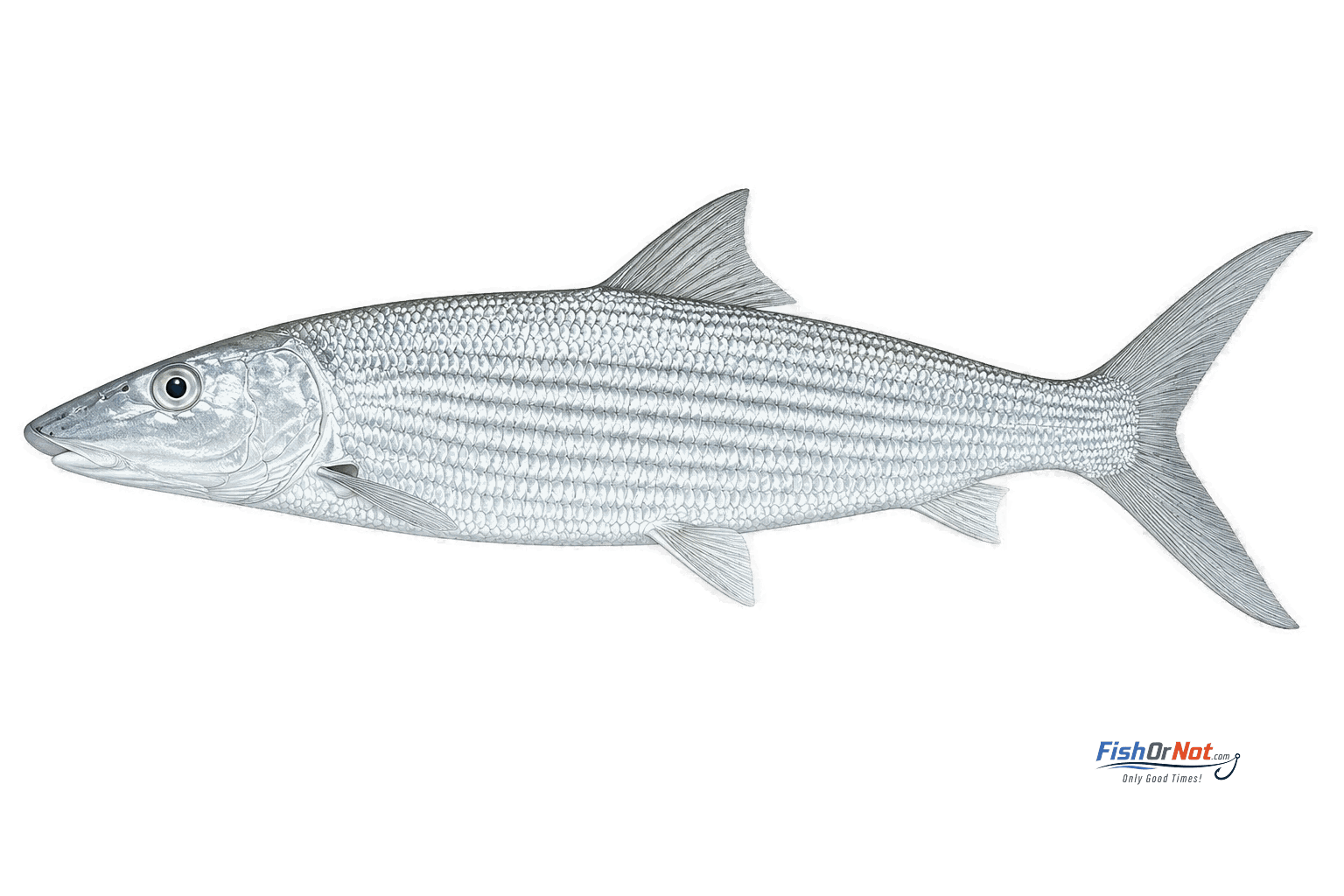
Bonefish
Albula vulpes
Saltwater
▼
🎣 How to Catch Them
Baits & Lures — Best / Medium / Poor
Live shrimpSpawning shrimp fly patternsSmall crab imitationsGulp shrimp (scented)Small jigs (1/8 oz)Permit crab patternsLarge luresFast retrievesBottom rigs (spooked by weight)
Optimal Lure Colour
Natural tan/pink shrimp imitations; small crab patterns
Retrieve Speed
Short strips of 15–30 cm with pauses. Never move faster than the fish can track.
Movement Pattern
Intercept cast — never cast at the fish, cast 3 feet in front and at depth of feeding fish.
Gear
8–9 wt fly rod; light spinning 7 ft with 10–15 lb fluorocarbon leader.
📍 Where to Find Them
Habitat Zone
Tropical saltwater flats — hard sand/marl bottom with turtle grass
Depth Range
0–1.5 m / 0–5 ft on flats
Structure
Open flat potholes, channel edges, mangrove shorelines
🏆 The Verdict
Fight Rating
★★★★★ 5/5 — Pound-for-pound one of the fastest fish — blistering initial run of 150–200m, multiple runs
Eating Quality
Generally not eaten — bony, considered a revered catch-and-release species.
Size Range
0.5–9 kg · 1–20 lb
World Record
8.6 kg / 19 lb (Zululand, South Africa 1962)
🕐 When They Bite
Active Time
Morning, Midday (tide-dependent)
Best Season
Winter–Spring (Nov–May in Bahamas/Florida)
Water Temp
22–30°C / 72–86°F
Weather Sensitivity
Sensitive to cold — below 18°C becomes lethargic. Calm warm days ideal.
Water Clarity
Crystal clear essential for sight-fishing
📊 Biology & Behaviour
Feeding Type
Bottom feeder on crustaceans / tailing
Spawning
Full moon offshore migrations
Activity Pattern
Tide-driven — follows flooding tide onto shallow flats to feed
Schooling
Schools by size; tailing individually or in groups
Predator / Prey
Eats: shrimp, crabs, worms, small clams (roots out from bottom). Eaten by: barracuda, sharks, lemon sharks
♻ Catch & Release Notes
Pure C&R sport. Keep in water. Very quick revival — strong fish, revives within seconds. Remove hook quickly.
⚖ Typical Bag & Size Limits
No harvest is permitted in the Bahamas and most flats destinations; catch-and-release is the norm even where a limit exists. Check current regulations.
⚠ Always check local laws — regulations vary by jurisdiction and change annually.
Tropical and subtropical coastal flats worldwide — Florida Keys, Bahamas, Caribbean, Hawaii, Florida Bay. Premier destination: Andros Island, Bahamas.
Mahi-Mahi
Coryphaena hippurus
Saltwater
▼
🎣 How to Catch Them
Baits & Lures — Best / Medium / Poor
Ballyhoo (rigged)SquidsBright trolling skirtsFeathered jigsFlying fish imitationPoppersBottom rigsSlow presentationsNatural/dull colours
Optimal Lure Colour
Bright pink/chartreuse/blue for weedline trolling; flashy silver for casting
Retrieve Speed
Fast to very fast — aggressive species. Trolling: 6–9 knots.
Movement Pattern
Troll near weedlines; spot weed mat, circle it and cast. Keep one fish in water — school follows.
Gear
Medium-heavy 7 ft spinning or conventional, 30–50 lb braid, 40–60 lb fluoro leader.
📍 Where to Find Them
Habitat Zone
Open ocean — under floating weedlines (Sargasso mats), debris, FADs, colour changes
Depth Range
Surface to 15 m / 50 ft under structure
Structure
Floating debris, weed patches, colour changes, temperature breaks
🏆 The Verdict
Fight Rating
★★★★☆ 4/5 — Aerial acrobatics, brilliant colour change when boated, fast sizzling runs — one of the most spectacular sport fish
Eating Quality
Outstanding — among the finest-eating ocean fish. Firm, mild, moist white flesh. Best grilled or blackened.
Size Range
1–40 kg · 2–88 lb
World Record
39.9 kg / 88 lb (Costa Rica 1976)
🕐 When They Bite
Active Time
Daytime / All day (pelagic)
Best Season
Spring–Summer offshore (Apr–Aug on Atlantic coast)
Water Temp
21–30°C / 70–86°F
Weather Sensitivity
Active year-round in tropics; concentrates around storm-washed debris
Diurnal pelagic feeder; highly aggressive when found
Schooling
Schools under floating debris/weedlines; bulls often solitary or pairs
Predator / Prey
Eats: flying fish, squid, small tuna, baitfish. Eaten by: marlin, swordfish, large tuna
♻ Catch & Release Notes
Fast revival — extremely vigorous. Avoid exhaustion. Release quickly if not keeping for table.
⚖ Typical Bag & Size Limits
Daily bag limits apply in Florida and across US Atlantic waters. Check current regulations.
⚠ Always check local laws — regulations vary by jurisdiction and change annually.
Circumtropical and subtropical — offshore Atlantic, Pacific, Indian oceans. In North America: offshore Gulf of Mexico, Florida, Bahamas, and summer migrants up to New England. Year-round in Hawaii.
Extremely heat-sensitive. Never handle above 18°C water. Quick release essential.
⚖ Typical Bag & Size Limits
Varies widely.
⚠ Always check local laws — regulations vary by jurisdiction and change annually.
Native to eastern North America from Labrador to Georgia in the Appalachians. Introduced widely across western North America, Europe, South America, and beyond. Considered invasive in many western streams where it hybridizes with and displaces native bull trout and cutthroat.
Stationary bottom rig — wait for fish to find bait.
Movement Pattern
Dead still on bottom. Occasional lift-drag to release scent.
Gear
Heavy 8–9 ft rod, 50–80 lb braid, 80–100 lb fluoro leader, heavy octopus or circle hooks.
📍 Where to Find Them
Habitat Zone
Deep river channels, lake basins, rocky rapids during spawn
Depth Range
5–30 m / 16–100 ft
Structure
Rocky substrate, river bends, deep lake basins with invertebrate-rich mud bottom
🏆 The Verdict
Fight Rating
★★★★★ 5/5 — Prehistoric power — pure weight and sustained bulldogging. Large fish run 200+ meters of line.
Eating Quality
Historically prized. Caviar from eggs was commercially valuable. Most jurisdictions require C&R. Not eaten.
Size Range
10–90 kg · 22–200 lb
World Record
Great Lakes/St. Lawrence specimens over 100 kg documented historically
🕐 When They Bite
Active Time
Night, Low light
Best Season
Spring & Fall
Water Temp
10–18°C / 50–64°F
Weather Sensitivity
Active regardless of weather; barometric pressure response minimal
Water Clarity
Scent-driven; clarity less important than scent
📊 Biology & Behaviour
Feeding Type
Bottom feeder — vacuum suction
Spawning
Apr–Jun (rocky rapids — only every 4–7 years)
Activity Pattern
Nocturnal and crepuscular
Schooling
Loosely grouped in deep holes; staging groups near spawning rapids
Predator / Prey
Eats: chironomids, crayfish, clams, small fish (vacuum suction). Eaten by: humans historically; now virtually no predators
♻ Catch & Release Notes
Mandatory C&R in Ontario and most Great Lakes jurisdictions. Extremely stress-tolerant — strong fish. Minimum handling. Do not remove from water. Document and release quickly. Fish can live 150+ years.
⚖ Typical Bag & Size Limits
C&R only in most of range. Limited harvest seasons in Wisconsin and some other states.
⚠ Always check local laws — regulations vary by jurisdiction and change annually.
⚠ Species at Risk (Threatened) in Canada; Endangered in several US states
Great Lakes, St. Lawrence, Hudson Bay, Mississippi River system. Severely depleted by overfishing and habitat loss. Recovery ongoing through stocking and habitat restoration.
Found in:Lake Ontario
Common Carp
Cyprinus carpio
FreshwaterInvasive in parts
▼
🎣 How to Catch Them
Baits & Lures — Best / Medium / Poor
Corn (sweet corn)Boilies (fruity flavours)Dough ballsBread flakeWormsCrayfishLuresFast presentationsLive fish bait
Optimal Lure Colour
Natural/olive/brown; boilies in fruity attractor colours for European style
Retrieve Speed
Stationary presentation on bottom is standard. Fly fishing: nymph-style slow strip.
Movement Pattern
Hair rig on bottom with boilies or corn. Fly: cast to cruising/tailing fish.
Gear
European carp fishing: 12–13 ft carp rod, 15–20 lb braid, hair rig; North American: medium-heavy 7 ft spinning.
📍 Where to Find Them
Habitat Zone
Warm shallow bays, river backwaters, urban ponds and lakes
Depth Range
0.5–6 m / 2–20 ft
Structure
Muddy bottom, weed beds, root systems, silt areas
🏆 The Verdict
Fight Rating
★★★★☆ 4/5 — Incredibly powerful for size — sustained power runs, bulldog resistance. Large carp are genuine endurance battles on appropriate tackle.
Eating Quality
Edible but rarely eaten in North America. Popular table fish in Eastern Europe and Asia. Requires careful preparation (soak in brine).
Size Range
1–45 kg · 2–99 lb
World Record
45.6 kg / 100 lb 8 oz (France 2019 — mirror carp)
🕐 When They Bite
Active Time
Morning, Evening, Night
Best Season
Summer (warm water); Spring pre-spawn
Water Temp
18–28°C / 64–82°F
Weather Sensitivity
Most active in warm stable weather; feeding slows significantly in cold
Water Clarity
Tolerates turbid; often creates turbid conditions themselves
Hardy species — highly resilient. Use wet mat when unhooking. Carp are increasingly respected as a sport fish. Remove hooks carefully from hard mouth.
⚖ Typical Bag & Size Limits
Often no limit as they are considered invasive. Some jurisdictions prohibit live transport. Check local rules.
⚠ Always check local laws — regulations vary by jurisdiction and change annually.
Native to eastern Europe and Asia. Introduced worldwide — now globally ubiquitous in fresh and brackish water. Highly invasive in North America, Australia, and New Zealand where they degrade aquatic ecosystems.
Found in:Lake Ontario
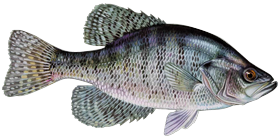
White Crappie
Pomoxis annularis
Freshwater
▼
🎣 How to Catch Them
Baits & Lures — Best / Medium / Poor
Small jigs (1/32–1/8 oz)Live minnows (small)Tube jigsCrappie spinnersSmall soft plasticsWorms (small pieces)Large luresFast presentationsBottom rigs in open water
Optimal Lure Colour
White/chartreuse/pink in most conditions; natural in clear
Retrieve Speed
Extremely slow to still — crappie will reject fast presentations
Movement Pattern
Vertical presentation at exact school depth. Slow pendulum swing with jig. Spider rigging for trolling.
Gear
Ultralight 5–6 ft rod, 4–6 lb mono, small spinning reel.
📍 Where to Find Them
Habitat Zone
Brush piles, standing timber, dock pilings, channels
Depth Range
1–8 m / 3–26 ft; suspends at exact depth
Structure
Submerged timber, brush piles, dock shadows, creek channel bends
🏆 The Verdict
Fight Rating
★★☆☆☆ 2/5 — Light and fun — delicate fight, great for families
Eating Quality
Excellent. White, sweet, flaky flesh. Among the finest panfish. Deep-fry or pan-fry.
Size Range
0.1–2 kg · 0.2–4.4 lb
World Record
2.35 kg / 5 lb 3 oz (Enid Dam, Mississippi 1957)
🕐 When They Bite
Active Time
Morning, Evening, Night
Best Season
Spring (pre-spawn); Year-round
Water Temp
15–23°C / 59–73°F
Weather Sensitivity
Consistent feeder; slightly more active in overcast stable weather
Water Clarity
White/chartreuse in stained; natural in clear; light attraction at night effective
📊 Biology & Behaviour
Feeding Type
Mid-water / Ambush predator (small)
Spawning
Apr–Jun (shallow nests on gravel/sand)
Activity Pattern
Nocturnal tendency especially in summer; highly light-sensitive
Schooling
Dense schooling — find the school location and stay put
Delicate mouth — handle gently. Resilient fish overall but soft structure around mouth.
⚖ Typical Bag & Size Limits
Generally liberal daily limits given their abundance, with size minimums common in many states. Check current regulations.
⚠ Always check local laws — regulations vary by jurisdiction and change annually.
Central and eastern US and southern Canada. Widely stocked nationally. Tolerates warmer, more turbid water than black crappie — common in southern impoundments.
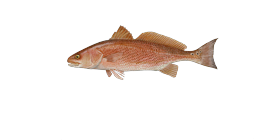
Red Drum
Sciaenops ocellatus
Saltwater
▼
🎣 How to Catch Them
Baits & Lures — Best / Medium / Poor
Live blue crabs (cut)Gold spoonsScented paddle tailsPopping corks with shrimpTopwater in low lightGulp shrimpSmall luresFast spinnerbaitsNatural dead bait without scent
Optimal Lure Colour
Gold/copper most effective; chartreuse/white; dark in turbid water
Retrieve Speed
Slow crawl with scented plastics on flats; medium retrieve in surf
Movement Pattern
Tailing fish: cast 3 feet ahead of direction of travel, let sink, slow crawl.
Slot limits apply and vary by state. Handle quickly — a resilient fish. Release oversized breeding fish horizontally with wet hands.
⚖ Typical Bag & Size Limits
Heavily regulated with slot and daily limits that vary by state. Check current regulations.
⚠ Always check local laws — regulations vary by jurisdiction and change annually.
Atlantic coast US from Massachusetts to Florida, entire Gulf of Mexico coast to Mexico. Most abundant in Gulf Coast estuaries (Texas, Louisiana, Florida). Premier sport fish on Gulf Coast.
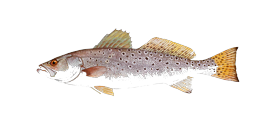
Spotted Seatrout
Cynoscion nebulosus
Saltwater
▼
🎣 How to Catch Them
Baits & Lures — Best / Medium / Poor
Live shrimp under corkSoft plastic jerkbaitsTopwater (dawn/dusk)Gold spoonsSuspending plugsPilchard (live)Bottom rigs onlyHeavy sinkersLarge lures over 15cm
Optimal Lure Colour
Chartreuse/white in stained; natural/silver/tan in clear
Retrieve Speed
Slow to medium; stop-and-go most effective
Movement Pattern
Walk-the-dog on surface at dawn. Slow sink-and-twitch with jerkbait. Under popping cork: steady hops.
Grass bed edges, oyster bars, drop-offs adjacent to shallow flats
🏆 The Verdict
Fight Rating
★★★☆☆ 3/5 — Scrappy, uses head shakes — soft mouth requires light hand. Fun on light tackle.
Eating Quality
Very good. White, mild, slightly flaky flesh. Highly prized in Gulf Coast cuisine.
Size Range
0.5–8 kg · 1–17 lb
World Record
7.9 kg / 17 lb 7 oz (Mason's Beach, Virginia 1977)
🕐 When They Bite
Active Time
Dawn, Dusk
Best Season
Spring & Fall
Water Temp
15–28°C / 59–82°F
Weather Sensitivity
Sensitive to rapid temperature drops. Best in stable warm periods.
Water Clarity
Natural/chartreuse in stained; natural/silver in clear
📊 Biology & Behaviour
Feeding Type
Mid-water / Surface ambush predator in estuaries
Spawning
Apr–Aug (shallow grass beds)
Activity Pattern
Crepuscular — peak activity at low light transitions
Schooling
Loose schools near structure
Predator / Prey
Eats: shrimp, mullet, pilchards, finger mullet. Eaten by: dolphins, sharks, larger game fish
♻ Catch & Release Notes
Soft mouth — use single barbless hooks where possible. Handle gently, do not squeeze. Quick release.
⚖ Typical Bag & Size Limits
Daily bag and minimum size limits apply and are tightly managed in Florida and the Gulf states. Check current regulations.
⚠ Always check local laws — regulations vary by jurisdiction and change annually.
Gulf of Mexico and Atlantic coast US — Cape Cod to Florida and entire Gulf. Most abundant in Florida estuaries and Texas Laguna Madre.
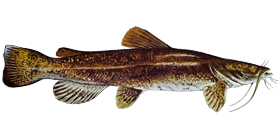
Flathead Catfish
Pylodictis olivaris
Freshwater
▼
🎣 How to Catch Them
Baits & Lures — Best / Medium / Poor
Live bluegillLive shadLive bullheadCut shad (large fresh)Live carp (small)Live perchDead or prepared baitsArtificial luresSmall hooks or bait
Optimal Lure Colour
Live bait driven — colour not relevant
Retrieve Speed
Stationary live bait presentation on bottom near structure
Movement Pattern
Secure heavy anchor. Drop live bait to bottom near cover. Wait.
Gear
Heavy 8–9 ft catfish rod, 80–130 lb braid, heavy live bait hooks 5/0–8/0.
📍 Where to Find Them
Habitat Zone
Large rivers — deep holes, bends, below wing dams, large woody debris
Depth Range
3–12 m / 10–40 ft in daytime; shallower at night
Structure
Large root wads, submerged logs, river bends, deep scour holes
🏆 The Verdict
Fight Rating
★★★★☆ 4/5 — Extremely powerful bulldog — large fish (20+ kg) can last an hour+. Head-locking into current.
Eating Quality
Excellent — considered best-eating catfish. Firm, white, mild flesh.
Size Range
1–55 kg · 2–121 lb
World Record
55.8 kg / 123 lb (Elk City Reservoir, Kansas 1998)
🕐 When They Bite
Active Time
Night, Dusk — strongly nocturnal
Best Season
Summer (warm nights)
Water Temp
22–28°C / 72–82°F
Weather Sensitivity
Warm stable weather optimal; thunderstorm activity can trigger movement
Water Clarity
Scent and vibration driven — clarity not critical
📊 Biology & Behaviour
Feeding Type
Bottom / Ambush predator — live prey preferred
Spawning
Jun–Jul (cavities, large woody debris)
Activity Pattern
Strongly nocturnal — prime time 10 pm to 2 am
Schooling
Solitary territorial predator
Predator / Prey
Eats: live fish (prefers live prey), crayfish, frogs. Eaten by: humans (apex predator)
♻ Catch & Release Notes
Extremely robust — highly stress tolerant. Remove hooks carefully. Large fish may need extended revival.
⚖ Typical Bag & Size Limits
Daily limits vary by state, with slot limits emerging on trophy rivers. Check current regulations.
⚠ Always check local laws — regulations vary by jurisdiction and change annually.
Large river systems of central and eastern US — Missouri, Mississippi, Ohio, Red River. Introduced in many western US rivers. Highly invasive in some Pacific coast rivers.
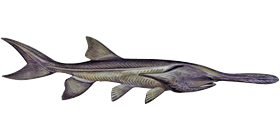
Paddlefish
Polyodon spathula
Freshwater⚠ Species at Risk
▼
🎣 How to Catch Them
Baits & Lures — Best / Medium / Poor
Large weighted treble snag hooks (snagging only — no bait attracted)—All traditional baits and lures — paddlefish are filter feeders and will not strike bait
Optimal Lure Colour
Large weighted treble snagging rig — not bait-based
Retrieve Speed
Controlled snagging sweep — sweep rod 30–45 degrees in arc repeatedly
Movement Pattern
Cast downstream, let sink, slow upstream retrieve with periodic sweeps.
Gear
Heavy 8 ft rod, 65–80 lb braid, large weighted treble snagging rig.
📍 Where to Find Them
Habitat Zone
Large open river channels, tributary mouths in spring
Depth Range
1–10 m / 3–33 ft; mid-water filter feeding
Structure
Open water, channel edges, tributary confluences
🏆 The Verdict
Fight Rating
★★★★☆ 4/5 — Cannot be caught on bait — legally snagged. Once hooked: powerful sustained runs, hard pulling.
Eating Quality
Excellent. White, mild flesh. Caviar (roe) extremely valuable. Often kept for eggs.
Size Range
3–90 kg · 7–198 lb
World Record
74.8 kg / 164 lb 12 oz (Lake of the Ozarks, Missouri 2019 — snagged)
🕐 When They Bite
Active Time
All day (filter feeding non-stop)
Best Season
Spring (snagging seasons)
Water Temp
10–20°C / 50–68°F
Weather Sensitivity
Spring warming and high water triggers spawning migration
Water Clarity
Does not respond to bait — structure and current location matter more
Constant filter feeding in open water; staggers in current
Schooling
Schools loosely in open river channels
Predator / Prey
Eats: zooplankton and tiny organisms via filter. Eaten by: no significant predators as adults
♻ Catch & Release Notes
Slow and careful revival required. Species at risk — check if season is open before targeting.
⚖ Typical Bag & Size Limits
Strictly regulated — many states allow only a very limited season, and some are closed to harvest entirely. Check current regulations carefully.
⚠ Always check local laws — regulations vary by jurisdiction and change annually.
⚠ Vulnerable / Species at Risk in multiple US states
Mississippi River basin and its major tributaries — Missouri, Ohio, Tennessee. Severely depleted by overfishing and dam construction. Small self-sustaining wild population; extensive stocking program ongoing.
Slow to medium in current — use current to animate jig
Movement Pattern
Cast upstream, drift through current seam, lift-drop along bottom.
Gear
Medium spinning 6–6.5 ft, 8–12 lb mono or fluorocarbon.
📍 Where to Find Them
Habitat Zone
Large fast rivers, tailwaters below dams, Rocky shoals
Depth Range
2–10 m / 7–33 ft
Structure
Wing dam tailwaters, rocky current seams, river bends, riprap
🏆 The Verdict
Fight Rating
★★★☆☆ 3/5 — Similar to walleye but smaller and from current — feels larger than size suggests
Eating Quality
Excellent. Nearly identical to walleye — white, flaky, mild. Often considered interchangeable.
Size Range
0.2–3 kg · 0.4–6.6 lb
World Record
3.96 kg / 8 lb 12 oz (Lake Sakakawea, North Dakota 1971)
🕐 When They Bite
Active Time
Dusk, Night
Best Season
Fall & Winter
Water Temp
10–18°C / 50–64°F
Weather Sensitivity
Active in cold water; fall cooling triggers aggression
Water Clarity
Highly turbid/stained water — more tolerant of turbidity than walleye
📊 Biology & Behaviour
Feeding Type
Mid-water / Bottom — similar to walleye but prefers faster current
Spawning
Mar–Apr (fast gravel shoals)
Activity Pattern
Nocturnal — similar to walleye
Schooling
Schools by size class in current
Predator / Prey
Eats: shiners, small perch, invertebrates. Eaten by: larger walleye, pike
♻ Catch & Release Notes
Hardy — similar to walleye. Standard handling.
⚖ Typical Bag & Size Limits
Often included in walleye aggregate limits. Check state/provincial rules.
⚠ Always check local laws — regulations vary by jurisdiction and change annually.
Mississippi and Missouri river drainages; southern Canada; Great Lakes tributaries. Less widely distributed than walleye. Populations largest in Missouri, Tennessee, and Cumberland rivers.
Extreme caution — razor teeth. Jaw spreader and long pliers mandatory. No fingers near mouth. Resilient fish — revive quickly.
⚖ Typical Bag & Size Limits
Daily bag limits apply on the Atlantic coast, tightly managed following stock depletion. Check current regulations.
⚠ Always check local laws — regulations vary by jurisdiction and change annually.
Worldwide in subtropical to temperate coastal waters — Atlantic coast of US (Maine to Florida), Mediterranean, West Africa, Australia (as 'Tailor'). Summer migration reaches Nova Scotia.
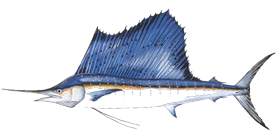
Sailfish
Istiophorus platypterus
Saltwater
▼
🎣 How to Catch Them
Baits & Lures — Best / Medium / Poor
Live ballyhooRigged ballyhoo (trolling)Live mullet/sardinesOffshore skirts (trolled)Squid (live/rigged)Circle hook pitch baitArtificial without natural scentSmall luresBottom presentations
Optimal Lure Colour
Natural ballyhoo; bright offshore skirts (pink/blue/black); live bait
Retrieve Speed
Trolling: 6–8 knots. Pitch bait to raised fish.
Movement Pattern
Troll spread of 4–6 baits at varied distances. When raised, free-spool and pitch live bait.
Gear
Medium 30 lb class tackle, 50–80 lb braid, wire or heavy fluoro leader, 80–130 lb class offshore reel.
📍 Where to Find Them
Habitat Zone
Open ocean — blue water beyond 50 m depth; weedlines; colour changes
Depth Range
0–50 m / 0–165 ft surface feeding
Structure
Temperature breaks, current edges, weedlines, FADs offshore
Mandatory C&R in most tournaments and responsible fisheries. Revive completely alongside boat. Revive time can be 10–15 minutes for large fish. Cut leader at boat if necessary for deep-hooked fish.
⚖ Typical Bag & Size Limits
Bag limits vary between state and federal waters; catch-and-release is best practice. Check current regulations.
⚠ Always check local laws — regulations vary by jurisdiction and change annually.
Tropical and subtropical oceans worldwide — Atlantic Sailfish on US Atlantic coast (Florida to Carolinas), Pacific Sailfish in Pacific Ocean. Premier destination: Florida Keys, Guatemala offshore.
Blue Marlin
Makaira nigricans
Saltwater
▼
🎣 How to Catch Them
Baits & Lures — Best / Medium / Poor
Live skipjack tunaRigged ballyhoo (large)Large offshore lures/skirtsLarge squid (rigged)Wahoo belly stripsBright trolling skirtsSmall luresInshore presentationsDead bait without movement
Optimal Lure Colour
Rigged ballyhoo; dark/black offshore skirts; large bright teaser fish
Retrieve Speed
Trolling: 8–10 knots in a spread pattern
Movement Pattern
Large spread with daisy chain teasers and pitch bait. Raise fish on teaser, remove teaser, pitch live bait.
Gear
130 lb class heavy offshore tackle, 200 lb+ braid, matched with 130 lb class reel holding 1,000+ m of line.
📍 Where to Find Them
Habitat Zone
Deep blue offshore water — beyond the continental shelf edge (300+ ft depth)
Depth Range
0–50 m while feeding; 200–600 m deep during rest
Structure
Offshore temperature breaks, canyon edges, seamounts
🏆 The Verdict
Fight Rating
★★★★★ 5/5 — The ultimate game fish. Hours-long battles with 400 kg+ fish. Explosive aerial acrobatics, blistering runs, sustained power that few anglers ever experience.
Eating Quality
Released in all serious sport fisheries — powerful conservation ethic. Poor eating quality anyway.
Size Range
90–820 kg · 198–1,800 lb
World Record
636 kg / 1,402 lb (Vitoria, Brazil 1992)
🕐 When They Bite
Active Time
Daytime
Best Season
Summer (peak in Bahamas, Caribbean Jul–Aug)
Water Temp
24–30°C / 75–86°F
Weather Sensitivity
Active post-storm when baitfish concentrate; calm blue-sky days can be productive
Water Clarity
Clear, warm, blue offshore water required
📊 Biology & Behaviour
Feeding Type
Pelagic apex predator — ram feeder
Spawning
Offshore, multiple times per year
Activity Pattern
Diurnal pelagic feeder following deep-water temperature breaks
Schooling
Generally solitary or pairs; occasional loose aggregations on bait schools
Predator / Prey
Eats: tuna, wahoo, mahi-mahi, large squid, flying fish. Eaten by: nothing as adults (apex)
♻ Catch & Release Notes
Standard practice in all serious sport fisheries. Full release mandatory in IGFA tournaments. Long revival with boat in reverse. Cut leader at boatside if fish can't be revived.
⚖ Typical Bag & Size Limits
Tightly restricted under federal and ICCAT management, with vessel-based limits. Catch-and-release is strongly advocated. Check current regulations.
⚠ Always check local laws — regulations vary by jurisdiction and change annually.
Tropical and subtropical Atlantic, Pacific, and Indian oceans. US access: offshore Florida, Bahamas, Carolinas, Gulf of Mexico. World-class destinations: Madeira, Azores, Kona (Hawaii), Cairns (Australia), Cabo San Lucas.
Bowfin
Amia calva
Freshwater
▼
🎣 How to Catch Them
Baits & Lures — Best / Medium / Poor
Live frogsLarge spinnerbaitsSwimbaitsTopwater poppersLive small fishCrankbaits (weedless)Artificial fliesSmall luresFast presentations far from cover
Optimal Lure Colour
Natural/white; chartreuse; dark patterns at night
Retrieve Speed
Slow to medium; erratic pauses near cover
Movement Pattern
Work around heavy cover. Erratic mid-water retrieve near weeds. Pop surface lure in stagnant pools.
Gear
Medium-heavy 7 ft spinning or baitcast, 20–30 lb braid, 30 lb fluorocarbon leader.
Dense vegetation, root mats, submerged timber in warm backwaters
🏆 The Verdict
Fight Rating
★★★★☆ 4/5 — Prehistoric power — violent, unpredictable, will not give up. Multiple runs and thrashing. Underrated fighter.
Eating Quality
Poor — mushy, strong-flavoured flesh. Not generally eaten. Pure sport fish.
Size Range
0.5–10 kg · 1–22 lb
World Record
9.8 kg / 21 lb 8 oz (Forest Lake, South Carolina 1980)
🕐 When They Bite
Active Time
Night, Dawn, Dusk
Best Season
Summer (warm stagnant water)
Water Temp
18–28°C / 64–82°F
Weather Sensitivity
Active in warm stable conditions; surface-gulps air in low-oxygen water
Water Clarity
Highly tolerant of low oxygen, turbid water — found where other fish cannot survive
📊 Biology & Behaviour
Feeding Type
Mid-water / Bottom ambush predator — can breathe air (air bladder)
Spawning
Apr–Jun (shallow nests, guarded by male)
Activity Pattern
Nocturnal to crepuscular; can survive in near-anoxic water
Schooling
Solitary predator
Predator / Prey
Eats: any fish, frogs, crayfish, mice. Eaten by: few predators — extremely hardy
♻ Catch & Release Notes
Extremely resilient — one of the toughest freshwater fish. Standard handling. Remove hook with long pliers — strong jaws and sharp teeth.
⚖ Typical Bag & Size Limits
Often no limit; considered rough fish in many states.
⚠ Always check local laws — regulations vary by jurisdiction and change annually.
Eastern North America — Great Lakes south through Mississippi and Atlantic drainages to Florida and Texas. The last living member of an ancient family (Amiidae) with 150 million year fossil record.
White Bass
Morone chrysops
Freshwater
▼
🎣 How to Catch Them
Baits & Lures — Best / Medium / Poor
Small white jigsChrome jigging spoonsInline spinners (white)Small crankbaitsLive shinersSoft plastics (shad shape)Large luresBottom rigsSlow presentations
Optimal Lure Colour
White/chartreuse/silver in open water
Retrieve Speed
Fast during blitzes to match bait speed. Medium retrieve for suspended fish.
Movement Pattern
Cast into swirl, fast straight retrieve. Jig vertically over suspended schools.
Gear
Light-medium 6–7 ft spinning, 8–10 lb mono or fluorocarbon, small reel.
📍 Where to Find Them
Habitat Zone
Open-water reservoirs; river tributaries during spring run; shallow flats chasing bait
Depth Range
0–10 m / 0–33 ft; surface during blitzes
Structure
Open water over structure (humps, channels), river current seams in spring
🏆 The Verdict
Fight Rating
★★★☆☆ 3/5 — Aggressive feeder — fast action when school located. Schools mean consecutive hookups.
Eating Quality
Good. Firm, white, slightly stronger flavour than walleye. Best fresh — doesn't freeze as well.
Size Range
0.2–3 kg · 0.4–6.6 lb
World Record
3.1 kg / 6 lb 13 oz (Lake Orange, Virginia 1989)
🕐 When They Bite
Active Time
Morning, Dusk
Best Season
Spring (spawning run); Summer (topwater blitzes)
Water Temp
14–22°C / 57–72°F
Weather Sensitivity
Surface blitzes common on windy days when shad pushed to surface
Water Clarity
White/chartreuse in all conditions — follows bait not cover
📊 Biology & Behaviour
Feeding Type
Mid-water / Surface — schooling predator on open-water baitfish
Spawning
Mar–May (river tributaries — exciting run fishery)
Activity Pattern
Crepuscular; midday can trigger surface blitzes chasing shad
Schooling
Tightly schooling — pack hunters driving bait to surface
Hardy. Wire or pliers to remove hooks — teeth are sharp. Quick revival.
⚖ Typical Bag & Size Limits
Daily limits vary by state and are often combined with other Esox species. Check current regulations.
⚠ Always check local laws — regulations vary by jurisdiction and change annually.
Eastern North America — Atlantic coast from Nova Scotia to Florida, Great Lakes, and Mississippi drainage. Most common esocid in New England and Mid-Atlantic coastal plain.
Excellent. Sweet, mild white flesh. One of the finest panfish. Best panfried whole or filleted.
Size Range
0.05–0.9 kg · 0.1–2 lb
World Record
2.2 kg / 4 lb 12 oz (Ketona Lake, Alabama 1950)
🕐 When They Bite
Active Time
Morning, Midday, Dusk
Best Season
Late Spring–Summer (spawning peak May–Jul)
Water Temp
18–27°C / 64–81°F
Weather Sensitivity
Active in warm stable weather; slows in cold fronts; most active during full moon spawning periods
Water Clarity
Natural/yellow in all conditions; chartreuse in stained
📊 Biology & Behaviour
Feeding Type
Mid-water / Surface — insect and invertebrate feeder
Spawning
May–Aug (shallow nests in colonies, male guards)
Activity Pattern
Diurnal — most active mid-morning through early afternoon
Schooling
Strongly schooling — colonies of nesting fish in spring; loose schools year-round
Predator / Prey
Eats: insects, worms, small crayfish, zooplankton, small fish. Eaten by: largemouth bass, pike, herons, osprey, otters
♻ Catch & Release Notes
Very resilient. Standard handling. C&R encouraged on large breeding fish to protect colony structure.
⚖ Typical Bag & Size Limits
Generally liberal daily limits given their abundance; some waters have no limit at all. Check current regulations.
⚠ Always check local laws — regulations vary by jurisdiction and change annually.
Native to eastern North America from the Great Lakes south to Florida and west to the Dakotas. Most widely distributed and most-caught freshwater fish in North America. Stocked virtually everywhere warm freshwater exists.
Black Crappie
Pomoxis nigromaculatus
Freshwater
▼
🎣 How to Catch Them
Baits & Lures — Best / Medium / Poor
Small jigs (1/32–1/8 oz)Live minnows (small)Tube jigsCrappie spinnersSmall soft plasticsFly patternsLarge luresFast presentationsBottom rigs in open water
Optimal Lure Colour
White/chartreuse in most conditions; natural silver in clear water
Retrieve Speed
Very slow to still — crappie will reject fast presentations
Movement Pattern
Vertical presentation at exact school depth. Slow pendulum. Spider rigging for trolling.
Gear
Ultralight 5–6 ft rod, 4–6 lb mono or fluorocarbon, small spinning reel.
📍 Where to Find Them
Habitat Zone
Clear water with submerged timber, vegetation, and brush piles
Depth Range
1.5–8 m / 5–26 ft; suspends at exact thermocline depth
Structure
Submerged timber, brush piles, dock shadows, creek channel bends, clear lake basins
🏆 The Verdict
Fight Rating
★★☆☆☆ 2/5 — Light, fun fight — soft mouth requires gentle hand. Great on ultralight.
Eating Quality
Excellent. Sweet white flesh, slightly firmer than white crappie. Pan-fry or deep-fry.
Size Range
0.1–2 kg · 0.2–4.4 lb
World Record
2.2 kg / 4 lb 8 oz (Kerr Lake, Virginia 1981)
🕐 When They Bite
Active Time
Dawn, Dusk, Night
Best Season
Spring (spawning run); Year-round
Water Temp
16–22°C / 61–72°F
Weather Sensitivity
Stable weather preferred; overcast days trigger daytime feeding
Water Clarity
Prefers clearer water than white crappie; natural/silver patterns most effective
📊 Biology & Behaviour
Feeding Type
Mid-water ambush predator — baitfish and invertebrates
Spawning
Apr–Jun (shallow nests, similar to white crappie)
Activity Pattern
Crepuscular to nocturnal; light-sensitive like walleye
Schooling
Dense schooling — suspends at precise depth over structure
Deep pools, undercut banks, riffles, beaver ponds, lake inflows
🏆 The Verdict
Fight Rating
★★★☆☆ 3/5 — Acrobatic — jumps and runs. Harder fighting than brook trout, approaching rainbow in spirit.
Eating Quality
Excellent. Pink flesh, mild flavour. Most anglers practice C&R.
Size Range
0.2–9 kg · 0.4–20 lb (subspecies-dependent)
World Record
18.6 kg / 41 lb (Pyramid Lake, Nevada 1925 — Lahontan subspecies)
🕐 When They Bite
Active Time
Dawn, Dusk
Best Season
Summer (high mountain streams); Spring & Fall (lower elevations)
Water Temp
8–16°C / 46–61°F
Weather Sensitivity
Active in overcast; terrestrial hatches during warm summer afternoons
Water Clarity
Natural/olive in clear mountain water; attractor patterns in stained
📊 Biology & Behaviour
Feeding Type
Surface / Mid-water — insect and small fish feeder
Spawning
Mar–Jul depending on subspecies and elevation
Activity Pattern
Crepuscular; mid-day active in cold high-elevation streams
Schooling
Loosely territorial; loosely grouped in pools
Predator / Prey
Eats: insects (terrestrials and aquatics), small fish, sculpin, mice. Eaten by: osprey, otters, bears, larger trout
♻ Catch & Release Notes
Mandatory C&R for most native subspecies. Handle with wet hands only. Quick release essential. Never fish above 18°C water.
⚖ Typical Bag & Size Limits
C&R only for most native subspecies. Stocked fish may have harvest limits — check local rules carefully.
⚠ Always check local laws — regulations vary by jurisdiction and change annually.
⚠ Multiple subspecies at risk; Westslope and Yellowstone cutthroat recovering under management
Western North America — Rocky Mountains from New Mexico to Alaska, Pacific coastal streams from California to Alaska. 14 recognized subspecies. Many are at-risk due to hybridization with introduced rainbow trout and habitat loss.
Sockeye Salmon
Oncorhynchus nerka
AnadromousFreshwater & Saltwater
▼
🎣 How to Catch Them
Baits & Lures — Best / Medium / Poor
Bright fly patterns (pink/chartreuse)Spinners (pink blade)Small spoonsBeads (pink/red)Small hoochiesJigging spoons in lakesBait (less effective than other salmon)Large luresBottom rigs
Optimal Lure Colour
Bright pink/chartreuse/red — sockeye respond to colour aggression not feeding instinct
Retrieve Speed
Slow drift or swing through pools; occasional twitches to trigger strike
Movement Pattern
Swing fly through holding pools. Cast above fish, mend to get fly to their level.
Gear
7–8 wt fly rod; medium spinning 7–8 ft, 10–15 lb braid on river runs.
📍 Where to Find Them
Habitat Zone
Open ocean; river migration corridors; lake systems with spawning tributaries
Depth Range
0–30 m / 0–100 ft in ocean; river surface to mid-depth on run
Structure
River pools, eddies behind boulders, lake inflow channels
🏆 The Verdict
Fight Rating
★★★★☆ 4/5 — Fast acrobatic runs, multiple jumps — one of the most exciting salmon on a fly rod
Eating Quality
Outstanding. Deep red-orange flesh, rich omega-3 fat. Best eating of all Pacific salmon.
Size Range
1.5–7 kg · 3–15 lb
World Record
6.9 kg / 15 lb 3 oz (Kenai River, Alaska 1987)
🕐 When They Bite
Active Time
Daytime (ocean); all hours on spawning run
Best Season
Jul–Sep (spawning run)
Water Temp
6–14°C / 43–57°F
Weather Sensitivity
Enters rivers on rising water; cooler temperatures trigger migration
Water Clarity
Bright pink/red flies in clear; chartreuse in turbid
📊 Biology & Behaviour
Feeding Type
Filter feeder in ocean (zooplankton); does not eat in freshwater spawning run
Spawning
Jul–Oct (lake inlet/outlet gravel streams)
Activity Pattern
Schooling migration — aggressive territorial response triggers strikes on spawning run
Barbless hooks mandatory on many rivers. Quick release. Kokanee — gentle handling as they are smaller.
⚖ Typical Bag & Size Limits
Strictly limited on most rivers, with many waters catch-and-release for wild fish. Check current regulations.
⚠ Always check local laws — regulations vary by jurisdiction and change annually.
Pacific coast from Oregon to Alaska; major runs in Fraser, Skeena, Columbia, and Copper rivers. Landlocked form (Kokanee) stocked widely in mountain lakes across western North America.
Stationary or slow drift presentation on or near bottom
Movement Pattern
Anchor in current above feeding ledge. Fresh-cut shad drifted into zone.
Gear
Heavy 8–9 ft catfish rod, 65–130 lb braid, 8/0–10/0 circle hooks. Rod holders mandatory for large fish.
📍 Where to Find Them
Habitat Zone
Large rivers — main channel depth, tailwaters below dams, large reservoirs
Depth Range
3–20 m / 10–65 ft; shallower at night feeding
Structure
Main channel ledges, submerged humps, tailwater foam lines, river bends
🏆 The Verdict
Fight Rating
★★★★★ 5/5 — Trophy blue catfish over 30 kg are genuine hour-long battles — powerful sustained runs and bulldogging in current
Eating Quality
Excellent. Firm, white, mild flesh. Highly prized table fish. Best fresh — pan-fry or deep-fry.
Size Range
1–60 kg · 2–130 lb
World Record
59 kg / 130 lb (Kerr Lake, Virginia/NC 2011)
🕐 When They Bite
Active Time
Night, Dusk — most active after dark
Best Season
Summer (warm water peak); Spring (spawning aggression)
Water Temp
21–28°C / 70–82°F
Weather Sensitivity
Warm stable summer nights most productive; feeding intensifies on dropping barometer
Water Clarity
Scent-driven; tolerates turbid water well
📊 Biology & Behaviour
Feeding Type
Mid-water / Bottom — active predator and scavenger
Spawning
May–Jul (cavities, undercut banks)
Activity Pattern
Primarily nocturnal; actively hunts in current unlike channel catfish
Schooling
Loose aggregations in deeper holes; territorial at prime feeding spots
Predator / Prey
Eats: shad, skipjack herring, carp, crawfish, mussels. Eaten by: humans (apex predator in most systems)
♻ Catch & Release Notes
Extremely robust. Large fish need extended revival. Support body horizontally — never lift vertically by jaw on fish over 10 kg.
⚖ Typical Bag & Size Limits
Daily limits vary by state, with trophy slot limits emerging on major trophy rivers. Check current regulations.
⚠ Always check local laws — regulations vary by jurisdiction and change annually.
Mississippi, Missouri, Ohio, and Rio Grande river drainages. Widely introduced east and west. Considered invasive in Chesapeake Bay tributaries and some Pacific coast rivers where they devastate native fish populations.
Same protocol as muskie — jaw spreader, long pliers, keep in water. Tiger muskies are sterile and stocked — each fish represents significant hatchery investment.
⚖ Typical Bag & Size Limits
Strict slot limits apply — often catch-and-release, or a single fish over a minimum size. Check current regulations.
⚠ Always check local laws — regulations vary by jurisdiction and change annually.
Not native — artificial hybrid of muskellunge and northern pike. Widely stocked in reservoirs and lakes throughout US and Canada as a trophy sport fish. Self-sustaining populations impossible as hybrid is sterile.
Alligator Gar
Atractosteus spatula
Freshwater
▼
🎣 How to Catch Them
Baits & Lures — Best / Medium / Poor
Large live carp or buffaloLarge live shadRope lure (braided rope frays hook bony jaw)Large cut baitLive mulletLarge swimbaits (slow retrieve)Small baitsFast presentationsStandard hooks (hard to penetrate bony jaw)
Optimal Lure Colour
Scent/vibration driven — large live baitfish presentation
Retrieve Speed
Still fishing — allow gar to fully engulf bait before setting hook (2–3 minutes)
Movement Pattern
Locate by surface rolling, anchor upstream, float large live bait to holding area.
Gear
Heavy 8–9 ft boat rod, 130 lb braid, 150 lb steel cable or wire leader. Rope gar rig for bowfishing.
📍 Where to Find Them
Habitat Zone
Large slow rivers, oxbow lakes, coastal bays, flooded backwaters
Depth Range
0.5–5 m / 2–16 ft; surfaces to breathe
Structure
Fallen timber in backwaters, river bends, oxbow lake structure, coastal marsh edges
🏆 The Verdict
Fight Rating
★★★★★ 5/5 — Prehistoric power — massive body weight, thrashing rolls, runs of 100+ meters. Setting the hook through bony jaws requires heavy tackle and patience.
Eating Quality
Edible — white, firm flesh but rarely eaten. Eggs are toxic to humans and most mammals. Pure C&R fishery.
Size Range
20–140 kg · 44–310 lb
World Record
Over 140 kg / 309 lb documented. IGFA record: 126.1 kg / 279 lb (Rio Grande, TX 1951)
🕐 When They Bite
Active Time
Night, Dusk, Dawn
Best Season
Summer (warm shallow water feeding)
Water Temp
20–30°C / 68–86°F
Weather Sensitivity
Active in hot stable summer weather; feeding slows significantly below 20°C
Water Clarity
Tolerates turbid, warm, low-oxygen water that other species cannot survive
📊 Biology & Behaviour
Feeding Type
Ambush predator — can breathe air via primitive lung
Spawning
Apr–Jun (shallow flooded backwaters and oxbows)
Activity Pattern
Nocturnal to crepuscular; rolls at surface to breathe air — locates fish by surface rolling
Schooling
Solitary; loosely grouped near prime ambush habitat
Predator / Prey
Eats: large fish, waterfowl, turtles, small mammals. Eaten by: nothing as adult (apex)
♻ Catch & Release Notes
Use rope lure or circle hooks for best hook-up without deep hooking. Keep in water during unhooking — teeth are razor sharp. Revive thoroughly before release. Population depleted across much of range.
⚖ Typical Bag & Size Limits
Strictly regulated in Texas and other states, with tag systems required in some. Catch-and-release is encouraged. Check current regulations.
⚠ Always check local laws — regulations vary by jurisdiction and change annually.
⚠ Species of concern in many states; protected in Illinois, Kentucky, Tennessee
Gulf Coast drainages from Texas to Florida, up Mississippi to Illinois. Historically far more widespread; now largely extirpated from northern range. Stronghold: Trinity River and Choke Canyon Reservoir, TX; Pearl River, MS.
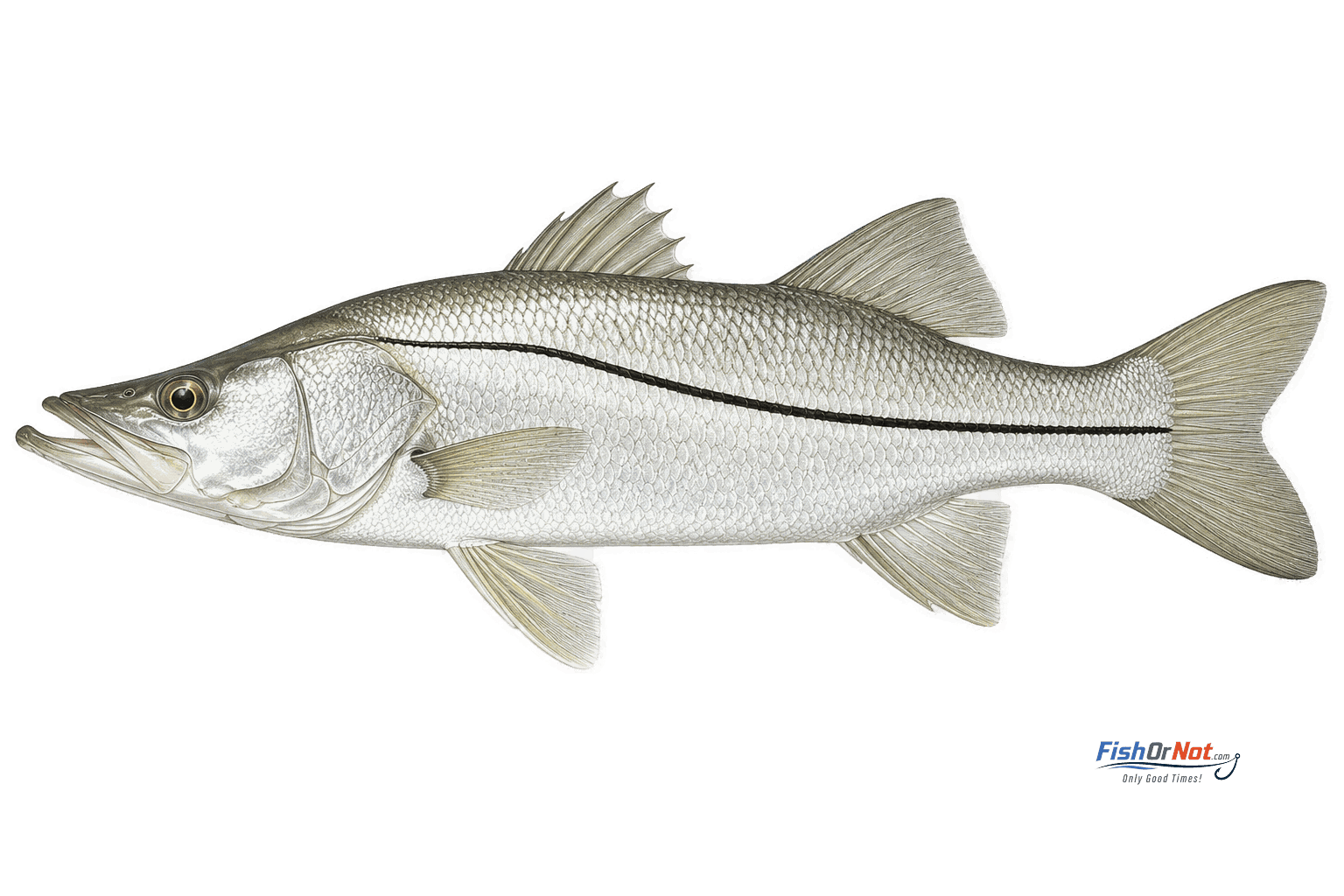
Snook
Centropomus undecimalis
Saltwater
▼
🎣 How to Catch Them
Baits & Lures — Best / Medium / Poor
Live pilchards/sardinesLive pinfishDOA shrimp (artificial)Swimbaits (white/chartreuse)Topwater plugs (dawn/dusk)Live shrimpBottom rigsHeavy sinkersSlow presentations away from structure
Optimal Lure Colour
White/chartreuse most versatile; natural/silver under bridge lights; dark patterns at night
Retrieve Speed
Medium-fast with direction changes; walk-the-dog on surface; slow suspending plug on cold days
Movement Pattern
Work mangrove edges on outgoing tide. Cast to current seams in passes. Under bridge lights: cast upcurrent, let lure swing through the light.
Mandatory C&R in closed season (May–Aug in Florida Gulf, Dec–Jan on Atlantic). Always check current season. Strong C&R ethic among serious snook anglers year-round for large fish.
⚖ Typical Bag & Size Limits
Tightly regulated in Florida with a narrow slot limit and closed seasons; rules change regularly. Check current FWC regulations.
⚠ Always check local laws — regulations vary by jurisdiction and change annually.
Atlantic coast from North Carolina to Brazil; Gulf of Mexico coast; Caribbean. In the US, primary range is Florida with range extending to Texas in warm years. Cannot survive prolonged cold.
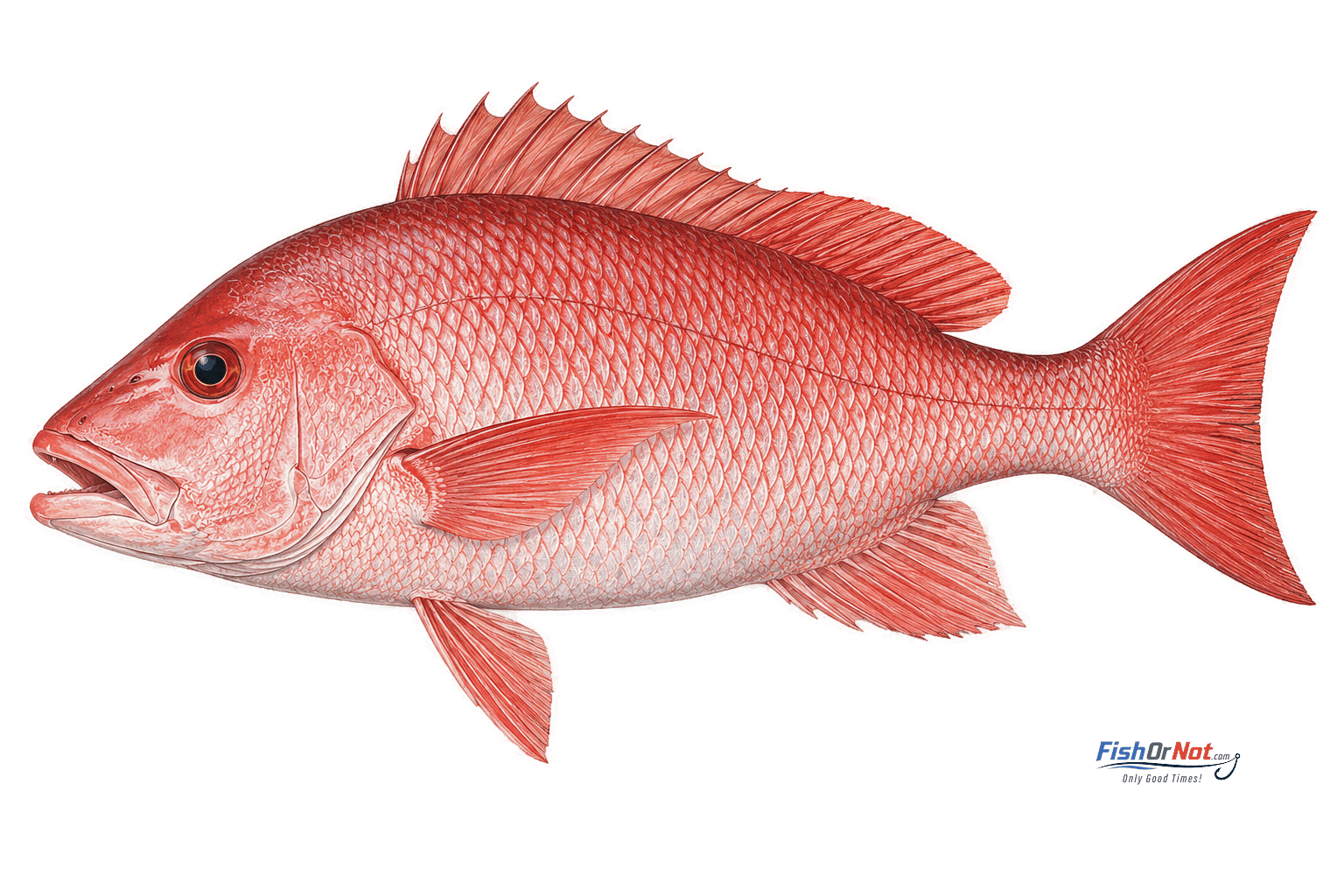
Red Snapper
Lutjanus campechanus
Saltwater
▼
🎣 How to Catch Them
Baits & Lures — Best / Medium / Poor
Cut squidLive/dead cigar minnowsLarge cut mulletVertical jigs (red/pink)Cut thread herringShrimp (large)Small hooksLight sinkers (need to hold bottom)Fast surface presentations
Optimal Lure Colour
Natural/red baits most effective; jigs in red/pink/white
Retrieve Speed
Bottom fishing — stationary. Jigging: fast vertical yo-yo 3–6 ft off bottom.
Movement Pattern
Drop to bottom, reel up 1–2 turns, hold or slow vertical jig. Current-compensating drift fishing also effective.
Gear
Medium-heavy 6–7 ft boat rod, 30–50 lb braid, 40–60 lb fluorocarbon leader, 4–6 oz sinker to hold bottom.
📍 Where to Find Them
Habitat Zone
Offshore reefs, oil platforms, artificial reefs, rocky bottom — typically 30–200 ft depth
Barotrauma critical — use descender device to return fish to depth. Do NOT leave fish at surface. If venting: use proper vent tool, not a knife.
⚖ Typical Bag & Size Limits
Strictly regulated by NOAA — Gulf season typically limited to a few weeks/year. State waters may differ. Check NOAA and state rules before every trip.
⚠ Always check local laws — regulations vary by jurisdiction and change annually.
Gulf of Mexico and US Atlantic coast from North Carolina to Florida. Heaviest concentrations in the northern and eastern Gulf of Mexico around natural reefs and the hundreds of oil platforms. Severely overfished historically; recovering under management.
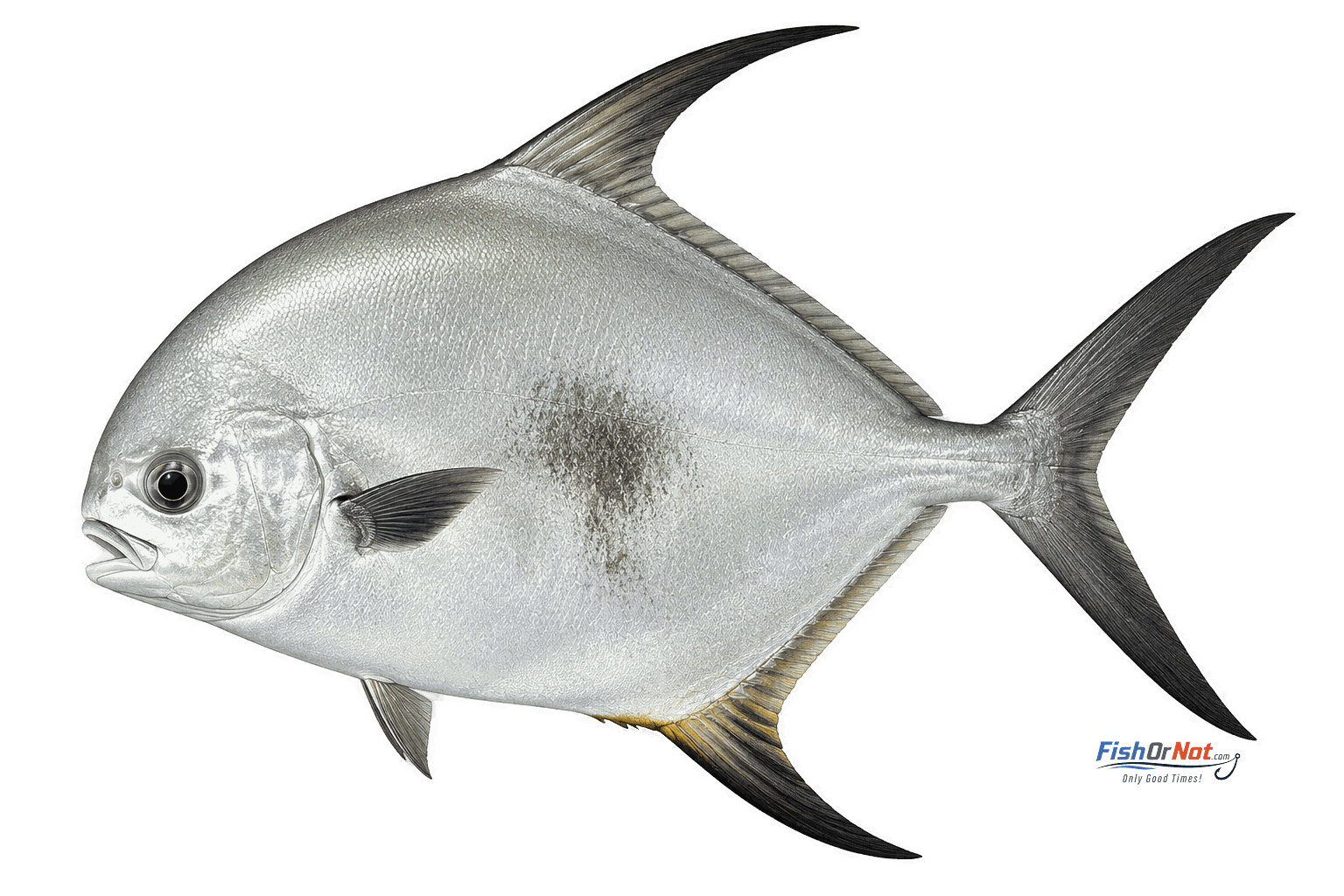
Permit
Trachinotus falcatus
Saltwater
▼
🎣 How to Catch Them
Baits & Lures — Best / Medium / Poor
Live crabs (small, fiddler or blue)Crab fly patterns (Del Brown permit crab)Live shrimpGulp crabSmall jigs (1/4 oz brown/tan)Live sand fleasFast presentationsLarge luresAnything unnatural-looking on calm flats
Optimal Lure Colour
Natural crab/tan imitations; small brown jigs
Retrieve Speed
Extremely slow — let crab pattern sink to bottom in front of tailing fish
Movement Pattern
Cast 6 feet ahead of direction of travel. Let pattern sink naturally. One slow strip only — then wait. Permit detect false movement immediately.
Open flat potholes, rubble bottom, wreck structure, channel edges adjacent to flats
🏆 The Verdict
Fight Rating
★★★★★ 5/5 — The holy grail of flats fishing — notoriously difficult to hook, then blistering runs and searing speed. Pound-for-pound among the strongest fish on flats.
Eating Quality
Good but almost universally released. Considered too valuable as a sport fish to keep.
Size Range
1–25 kg · 2–55 lb
World Record
27.2 kg / 60 lb (Bahia Honda, Florida 2018)
🕐 When They Bite
Active Time
Morning, Midday (tide-dependent)
Best Season
Spring–Fall (year-round in tropics)
Water Temp
22–30°C / 72–86°F
Weather Sensitivity
Warm calm days ideal. Becomes nervous and difficult in wind over 15 knots.
Water Clarity
Crystal clear essential for sight-fishing
📊 Biology & Behaviour
Feeding Type
Bottom feeder on crustaceans — tailing on flats
Spawning
Spring–Summer (offshore)
Activity Pattern
Tide-driven — follows flooding tide onto flats to tail on crabs
Schooling
Small schools to 20 fish; large specimens often solitary
Predator / Prey
Eats: crabs, shrimp, urchins, small fish. Eaten by: sharks, barracuda
♻ Catch & Release Notes
Universal C&R. Keep in water. Revive fully — permit tire easily. The flats grand slam (bonefish + permit + tarpon in one day) is the pinnacle of saltwater fly fishing.
⚖ Typical Bag & Size Limits
A daily bag limit applies in Florida, though most serious permit anglers release every fish. Check current regulations.
⚠ Always check local laws — regulations vary by jurisdiction and change annually.
Western Atlantic from Massachusetts to Brazil; Gulf of Mexico; Caribbean. Premier destinations: Florida Keys, Belize, Yucatan (Mexico), Bahamas.
Natural/brown/tan for eel imitations; bright colours for visual attraction
Retrieve Speed
Medium-fast; eels and jigs worked with darting action
Movement Pattern
Cast ahead of swimming cobia following a ray. Dart jig erratically. Cobia strikes out of aggression/curiosity as much as hunger.
Gear
Medium-heavy 7–7.5 ft spinning or conventional, 30–50 lb braid, 50–80 lb fluorocarbon leader.
📍 Where to Find Them
Habitat Zone
Open coast, inlets, nearshore reefs, around floating structure, buoys
Depth Range
0–20 m / 0–65 ft; surface-feeding during migration
Structure
Buoys, navigation markers, oil platforms, large rays and sharks (as pilots), reef edges
🏆 The Verdict
Fight Rating
★★★★★ 5/5 — Incredibly powerful for size — blistering runs, bulldogging dives, sustained resistance. One of the strongest inshore/nearshore fighters in North America.
Eating Quality
Outstanding. Firm, white, moist flesh. One of the finest-eating coastal fish. Best grilled or broiled.
Size Range
2–50 kg · 4–110 lb
World Record
61.5 kg / 135 lb 9 oz (Shark Bay, Australia 1985)
🕐 When They Bite
Active Time
Daytime / All day
Best Season
Spring (migration Apr–Jun on Atlantic/Gulf coast)
Water Temp
20–30°C / 68–86°F
Weather Sensitivity
Migration triggered by spring warming; follows thermal fronts north
Water Clarity
Clear to slightly stained; highly visual species
📊 Biology & Behaviour
Feeding Type
Mid-water / Bottom predator — follows large marine animals
Spawning
Jun–Aug (offshore)
Activity Pattern
Diurnal; follows rays, sharks, and turtles — highly visual feeder
Schooling
Loose groups during migration; solitary or paired at structures
Predator / Prey
Eats: crabs, fish, squid, eels. Eaten by: sharks, large tuna
♻ Catch & Release Notes
Resilient fish. Standard handling. Cobia are valuable — many anglers practice selective harvest of slot fish only.
⚖ Typical Bag & Size Limits
Bag and minimum size limits apply and differ between the Gulf and the Atlantic; rules are revised regularly. Check current regulations.
⚠ Always check local laws — regulations vary by jurisdiction and change annually.
Circumglobal in tropical and subtropical waters. In North America: Atlantic coast from Massachusetts to Brazil, entire Gulf of Mexico. Spring migration along US Atlantic coast from Florida north to Chesapeake Bay is a celebrated seasonal event.
Yellowfin Tuna
Thunnus albacares
Saltwater
▼
🎣 How to Catch Them
Baits & Lures — Best / Medium / Poor
Live skipjack/frigate mackerelChunked butterfishHigh-speed offshore skirtsVertical jigs (300–500g)Poppers (large, at surface schools)Live squidSmall luresSlow presentationsInshore tackle (will not handle a large fish)
Optimal Lure Colour
Natural baitfish imitations; bright offshore skirts; cedar plugs; chrome jigs
Retrieve Speed
Trolling: 7–10 knots. Jigging: fast vertical yo-yo with speed. Popping: explosive casts into blitzing fish.
Movement Pattern
Troll bait spread at speed. Chunk bait (slick) around FADs. High-speed popping into surface schools.
Gear
50–80 lb class offshore tackle; 80–130 lb braid; matched heavy offshore reel with 600+ m capacity.
📍 Where to Find Them
Habitat Zone
Open blue offshore water — beyond continental shelf; around FADs, weedlines, temperature breaks
Depth Range
0–100 m / 0–330 ft while feeding; much deeper at rest
Structure
FADs (fish aggregating devices), current edges, color changes, floating debris, around dolphin schools
🏆 The Verdict
Fight Rating
★★★★★ 5/5 — The ultimate offshore workout — blistering initial run of 300+ meters, sustained speed and power that tests angler and tackle alike. Large YFT are multi-hour battles.
Eating Quality
Outstanding. Prized above all other tuna for sashimi/sushi. Deep red flesh, buttery flavour. High commercial value.
Size Range
5–180 kg · 11–400 lb
World Record
176.4 kg / 388 lb 12 oz (Cabo San Lucas, Mexico 2012)
🕐 When They Bite
Active Time
Daytime (open ocean)
Best Season
Summer–Fall (Gulf of Mexico); Year-round (Hawaii)
Water Temp
18–31°C / 64–88°F
Weather Sensitivity
Calm post-front conditions often excellent; storm-washed debris concentrates fish
Water Clarity
Blue, warm, offshore water required
📊 Biology & Behaviour
Feeding Type
Pelagic open-ocean predator — speed hunter
Spawning
Multiple times per year offshore in warm water
Activity Pattern
Diurnal open-ocean feeder; follows temperature breaks and baitfish schools
Schooling
Tight schools — often mixed with skipjack and dolphins
Can C&R smaller fish with careful revival. Large fish often deeply exhausted — ensure full revival before release. Barbless hooks help with quick release.
⚖ Typical Bag & Size Limits
No federal recreational bag limit in the US, though state and territorial rules vary. Check current regulations.
⚠ Always check local laws — regulations vary by jurisdiction and change annually.
Circumtropical — all warm oceans between 40°N and 40°S. Major US fisheries: Gulf of Mexico, Atlantic offshore from Florida to New England, Hawaii (year-round), Pacific coast. World-class destinations: Cabo San Lucas, Kona (HI), Outer Banks (NC).
Dense schooling — largest runs by number of any Pacific salmon
Predator / Prey
Eats: zooplankton, small fish (ocean). Eaten by: orca, sea lions, bears, eagles
♻ Catch & Release Notes
Barbless hooks mandatory on many rivers. Only hatchery-marked (clipped adipose fin) fish may be kept on many rivers.
⚖ Typical Bag & Size Limits
Limits vary by river, often allowing hatchery fish while wild fish are catch-and-release. Check current regulations.
⚠ Always check local laws — regulations vary by jurisdiction and change annually.
Pacific coast Alaska to California; most abundant Pacific salmon species by number. Major runs in Puget Sound, BC, and Alaska. Odd-year runs only in most rivers. Introduced to Lake Superior with minor naturalized runs.
Barbless hooks required on most BC and Alaska rivers. Hatchery-marked fish only for harvest on many rivers.
⚖ Typical Bag & Size Limits
Hatchery fish may be kept where seasons are open, while wild fish are catch-and-release on many rivers. Check current regulations.
⚠ Always check local laws — regulations vary by jurisdiction and change annually.
Pacific coast from California to Alaska and into Arctic drainages; largest runs in Alaska, Yukon, BC. Second-largest Pacific salmon by weight. Important subsistence fishery for First Nations and Alaska Native peoples.
Barotrauma if from deep — use descender device. Resilient fish near shore.
⚖ Typical Bag & Size Limits
Strictly managed by NOAA in the north-east US, with seasons and limits that change annually. Check current regulations.
⚠ Always check local laws — regulations vary by jurisdiction and change annually.
US Atlantic coast from Maine to Florida. Migrates seasonally — inshore and north in summer, offshore and south in winter. Highly popular nearshore fishery from New Jersey to North Carolina.
Summer Flounder
Paralichthys dentatus
Saltwater
▼
🎣 How to Catch Them
Baits & Lures — Best / Medium / Poor
Bucktail jig + Gulp (white/chartreuse)Live killies (mummichog)Live spearingStrip baits (squid/mullet)Snap jigsSoft plastics (paddle tail)Bottom rigs without movementLarge heavy luresFast presentations
Optimal Lure Colour
White/chartreuse most effective; natural/tan in clear water
Retrieve Speed
Slow drift along bottom
Movement Pattern
Drift with current, bounce bucktail on sandy bottom. Pause, lift 30 cm, drop. Fluke hit on the fall.
Gear
Medium 7 ft spinning, 15–20 lb braid, 20–25 lb fluorocarbon leader, 1–3 oz bucktail.
Daily bag and minimum size limits apply across the north-east US and vary by state; rules change annually. Check current regulations.
⚠ Always check local laws — regulations vary by jurisdiction and change annually.
US Atlantic coast from Maine to Florida. Inshore in summer, offshore in winter. One of the most popular recreational species on the Northeast coast from May to September.
Fast revival. Sharp teeth — use dehooker or heavy gloves. Tail-rope large fish before bringing aboard.
⚖ Typical Bag & Size Limits
No federal limit in US. Generally liberal. Hawaii: some area restrictions.
⚠ Always check local laws — regulations vary by jurisdiction and change annually.
Circumtropical offshore waters. In North America: Atlantic from Cape Hatteras to Florida, Gulf of Mexico, Caribbean, Pacific coast, and Hawaii year-round (most targeted fish there as ono).
Greater Amberjack
Seriola dumerili
Saltwater
▼
🎣 How to Catch Them
Baits & Lures — Best / Medium / Poor
Live pinfish/pogiesSlow-pitch jigs (200–400g)Large vertical jigsLive squidLarge swimbaitsFresh cut baitSmall luresSlow static presentationsLight tackle (will be broken)
Optimal Lure Colour
Bright flashy jigs; natural baitfish imitations
Retrieve Speed
Fast vertical jigging — amberjack respond to speed and aggression
Movement Pattern
Drop jig to bottom, fast yo-yo retrieve. Live bait under float near structure. Slow-pitch jigging also effective.
Gear
Heavy 7 ft boat rod, 65–130 lb braid, 80–100 lb fluorocarbon leader. Heavy jigging or live bait setup.
★★★★★ 5/5 — Relentless bulldogging dives back to structure, powerful runs, and sheer stamina. Large AJ over 20 kg will punish under-gunned tackle. Earned the nickname "reef donkey."
Eating Quality
Fair — oily flesh with parasites common. Most serious anglers release. Smaller fish under 10 kg better eating.
Size Range
2–70 kg · 4–154 lb
World Record
70.5 kg / 155 lb 10 oz (Challenger Bank, Bermuda 1981)
Diurnal; schools around deep reef structure; juvenile fish often at surface around floating debris
Schooling
Loose to tight schools around reef structure by size
Predator / Prey
Eats: fish, squid, crustaceans. Eaten by: large sharks
♻ Catch & Release Notes
Barotrauma at depth — use descender device. Revive before release. Handle with care.
⚖ Typical Bag & Size Limits
Strictly managed with vessel and size limits that differ between the Gulf and the Atlantic, and change annually. Check current NOAA regulations.
⚠ Always check local laws — regulations vary by jurisdiction and change annually.
Tropical and subtropical Atlantic, Pacific, and Indian oceans. In North America: Gulf of Mexico and US Atlantic coast. Most abundant around natural and artificial reefs in the northern Gulf.
Gag Grouper
Mycteroperca microlepis
Saltwater
▼
🎣 How to Catch Them
Baits & Lures — Best / Medium / Poor
Live pinfishLive gruntsLive squirrelfishCut squidLarge frozen cigar minnowsSlow-pitch jigsSmall hooksLight line (cut off instantly)Fast surface presentations
Optimal Lure Colour
Natural baitfish colours; white/silver jigs
Retrieve Speed
Bottom fishing: stationary. Jigging: slow to medium vertical.
Movement Pattern
Drop to structure, hold 1–2 feet off bottom. Slow-pitch jig through strike zone. When grouper hits — lean back hard immediately and do not give line.
Gear
Heavy 6–7 ft boat rod, 65–80 lb braid, 60–80 lb fluorocarbon. Must stop fish on first run — no compromise on tackle.
📍 Where to Find Them
Habitat Zone
Natural and artificial reef, rocky bottom, ledges
Depth Range
5–100 m / 16–330 ft; juveniles in shallow grass beds
Structure
Natural rock ledges, wrecks, artificial reefs, offshore rocky bottom
🏆 The Verdict
Fight Rating
★★★★☆ 4/5 — Explosive initial dive back into structure after hookup — must stop first run immediately or fish cuts off on reef. Powerful sustained resistance once clear.
Eating Quality
Outstanding. Firm, white, sweet flesh. Among the most prized eating fish in the Gulf and Southeast Atlantic.
Solitary to small groups; large spawning aggregations offshore
Predator / Prey
Eats: fish, squid, octopus, crabs, shrimp. Eaten by: large sharks
♻ Catch & Release Notes
Barotrauma critical — always use descender device. Descending is far more effective than venting.
⚖ Typical Bag & Size Limits
Heavily managed with seasonal closures, bag limits and size minimums that change annually. Check current NOAA regulations for the open season.
⚠ Always check local laws — regulations vary by jurisdiction and change annually.
Atlantic coast from North Carolina to Florida and throughout Gulf of Mexico. One of the most commercially and recreationally important reef fish in the US Southeast.
Quick revival. Sharp teeth — use dehooker. Barbless hooks aid release.
⚖ Typical Bag & Size Limits
Generally liberal daily limits given their abundance, across both the Gulf and the Atlantic. Check current regulations.
⚠ Always check local laws — regulations vary by jurisdiction and change annually.
US Atlantic coast from Chesapeake Bay to Florida, Gulf of Mexico. Seasonal migrant following warm water north in spring, south in fall. Enormous populations; one of the most accessible saltwater species on the Southeast coast.
Daily bag and minimum size limits apply in Florida, and rules vary across the Gulf and Atlantic states. Check current regulations.
⚠ Always check local laws — regulations vary by jurisdiction and change annually.
Atlantic coast from Massachusetts to Brazil; Gulf of Mexico. Seasonal migrant following warm water. Most abundant on Florida Atlantic and Gulf coasts year-round.
Sheepshead
Archosargus probatocephalus
Saltwater
▼
🎣 How to Catch Them
Baits & Lures — Best / Medium / Poor
Live fiddler crabsLive sand fleasOysters (fresh, crushed)Shrimp (fresh, small piece)Barnacles (scraped off pilings)Clam stripsArtificial luresFish-based baitsLarge hooks or baits
Optimal Lure Colour
Natural/tan; fiddler crab imitations
Retrieve Speed
Still fishing — sheepshead pick bait, they do not chase
Movement Pattern
Position bait directly on piling face or oyster bar. Ultra-light touch on the rod — bite is barely a tap.
Gear
Medium 7 ft spinning, 15–20 lb fluorocarbon leader. Small, sharp #1–2/0 hooks mandatory — bite is very subtle.
📍 Where to Find Them
Habitat Zone
Pilings, docks, jetties, oyster bars, bridges — any hard structure with barnacles
Depth Range
0–10 m / 0–33 ft
Structure
Bridge pilings, dock posts, jetty rock, oyster bars, natural rock ledges
🏆 The Verdict
Fight Rating
★★★☆☆ 3/5 — Strong circular resistance and powerful dives into structure — harder to land than size suggests
Eating Quality
Excellent. Firm, white, sweet flesh. One of the finest eating inshore fish. Difficult to fillet but worth the effort.
Size Range
0.3–9 kg · 0.7–20 lb
World Record
9.6 kg / 21 lb 4 oz (New Orleans, Louisiana 1982)
🕐 When They Bite
Active Time
Morning, Moving tide
Best Season
Winter–Spring (spawning aggregations Feb–Apr)
Water Temp
14–26°C / 57–79°F
Weather Sensitivity
Active in cold water — one of the few species that feeds aggressively in winter
Water Clarity
Tolerates turbid water — feeds by crushing and feel, not sight
📊 Biology & Behaviour
Feeding Type
Bottom feeder — crushing mollusks and crustaceans with human-like molar teeth
Resilient. Heavy scales protect fish well. Standard handling.
⚖ Typical Bag & Size Limits
Daily bag and minimum size limits apply in Florida, and rules vary across the Gulf states. Check current regulations.
⚠ Always check local laws — regulations vary by jurisdiction and change annually.
Atlantic coast from Cape Cod to Brazil; Gulf of Mexico. Most abundant from Florida to Texas. Winter spawning aggregations at passes and inlets are a celebrated Gulf Coast fishery.
Spotted Bass
Micropterus punctulatus
Freshwater
▼
🎣 How to Catch Them
Baits & Lures — Best / Medium / Poor
Drop shot (finesse worm)Ned rigTube jigsSmall crankbaitsInline spinnersFinesse jigsVery large luresHeavy cover presentationsSlow worm rigs in warm water
Optimal Lure Colour
Green pumpkin, natural, and shad colours most effective
Retrieve Speed
Medium — drop shot and finesse work well; faster for active fish
Movement Pattern
Drop shot works exceptionally well. Ned rig on rocky points. Shaky head in current seams.
Gear
Medium spinning or light baitcast 6.5–7 ft, 8–12 lb fluorocarbon.
📍 Where to Find Them
Habitat Zone
Rivers and reservoirs — rocky current seams, eddies, deeper structure
Depth Range
1–12 m / 3–40 ft; deeper than largemouth, shallower than typical smallmouth
Structure
Rocky ledges, gravel points, current breaks, submerged timber in clear reservoirs
🏆 The Verdict
Fight Rating
★★★★☆ 4/5 — Pound-for-pound rivals smallmouth — fast, acrobatic, multiple jumps. Often fights harder than size suggests.
Eating Quality
Good. Firm white flesh. Most anglers C&R.
Size Range
0.1–3.5 kg · 0.2–8 lb
World Record
4.6 kg / 10 lb 4 oz (Pine Flat Lake, California 2012)
🕐 When They Bite
Active Time
Dawn, Dusk
Best Season
Spring & Summer
Water Temp
16–24°C / 61–75°F
Weather Sensitivity
Aggressive before fronts; shuts down post-cold-front
Water Clarity
Prefers clear water; green/natural in clear; chartreuse in stained
📊 Biology & Behaviour
Feeding Type
Mid-water / Top ambush predator
Spawning
Mar–May (gravel beds 1–3m)
Activity Pattern
Crepuscular; more current-oriented than largemouth bass
Schooling
Semi-territorial; loose groups in current seams and eddies
Often included in bass aggregate limits. California has special spotted bass rules in some reservoirs.
⚠ Always check local laws — regulations vary by jurisdiction and change annually.
Ohio and Mississippi river drainages from Ohio south to Gulf Coast; introduced in reservoirs throughout US and into California where trophy populations now rival world records.
Hardy. Same handling as bluegill. Protect large breeding fish from spawning beds.
⚖ Typical Bag & Size Limits
Usually included in a combined panfish limit, which is generally liberal. Check current regulations.
⚠ Always check local laws — regulations vary by jurisdiction and change annually.
Southeastern US — Atlantic coast from Virginia to Florida, Gulf Coast states to Texas. Introduced throughout US in warm ponds and reservoirs. Most abundant in Florida, Alabama, Georgia, and Mississippi.
Arctic and sub-arctic rivers, cold mountain streams, clear northern lakes
Depth Range
0–4 m / 0–13 ft
Structure
Swift riffle tails, deep pool heads, inlet streams of arctic lakes
🏆 The Verdict
Fight Rating
★★★☆☆ 3/5 — Acrobatic — the spectacular iridescent dorsal fin flares beautifully during fight. Spirited for size. Fishing for grayling in remote arctic wilderness is as much about the experience as the fish.
Eating Quality
Excellent. Delicate, mild pink flesh. Best eaten streamside the same day.
Size Range
0.2–3 kg · 0.4–6.6 lb
World Record
2.7 kg / 5 lb 15 oz (Katseyedie River, NWT 1967)
🕐 When They Bite
Active Time
All day (arctic summer — 24-hour daylight)
Best Season
Summer (Jun–Aug in arctic)
Water Temp
4–14°C / 39–57°F
Weather Sensitivity
Active in all summer conditions; surface feeding peaks during mayfly and caddis hatches
Water Clarity
Crystal clear arctic water — precise presentations required
📊 Biology & Behaviour
Feeding Type
Surface / Mid-water — insect feeder
Spawning
Apr–Jun (gravel riffle streams)
Activity Pattern
Diurnal to all-day in arctic summer; aggressive surface feeders during hatches
Schooling
Loose schools in pools; territorial during hatches
Predator / Prey
Eats: insects (primarily), small fish, zooplankton. Eaten by: Arctic char, lake trout, otters, mergansers
♻ Catch & Release Notes
Mandatory C&R for wild populations in most of US range. Wet hands only. Quick release.
⚖ Typical Bag & Size Limits
Catch-and-release only for most US populations, with limited harvest in parts of Alaska. Check current regulations carefully.
⚠ Always check local laws — regulations vary by jurisdiction and change annually.
⚠ Species of concern in contiguous US; Montana population isolated and at risk
Arctic and sub-arctic North America from Alaska east to Hudson Bay; isolated relic population in Montana (Big Hole River). Also Siberia and northern Europe. Requires pristine cold, clear water — indicator species for watershed health.
Bull Trout
Salvelinus confluentus
Freshwater⚠ Species at Risk
▼
🎣 How to Catch Them
Baits & Lures — Best / Medium / Poor
Large streamer flies (olive/white)Small spoons (silver)Live/dead small fish (where legal)Large nymphsSpinners (small)Slow plugsInsect patterns aloneSmall dry fliesFast presentations in cold water
Optimal Lure Colour
Natural fish-imitating patterns; olive/white streamer flies; small spoons
Retrieve Speed
Slow to medium — streamer swing in current; slow trolling in lakes
Movement Pattern
Swing large streamer patterns through deep cold pools. Troll white/silver plugs near lake inflows.
Gear
Medium 8–9 ft fly rod (6–7 wt); medium spinning, 10–14 lb fluorocarbon.
📍 Where to Find Them
Habitat Zone
Cold clear mountain rivers and lakes; coldest streams in any given system
Depth Range
1–8 m / 3–26 ft
Structure
Deep cold pools, undercut banks, cold spring seeps, lake inflow areas
🏆 The Verdict
Fight Rating
★★★★☆ 4/5 — Powerful, deep-diving resistance. Large bull trout are exceptional fighters in cold fast water.
Eating Quality
Good. Most jurisdictions require C&R — do not keep.
Size Range
0.3–10 kg · 0.7–22 lb
World Record
14.5 kg / 32 lb (Lake Pend Oreille, Idaho 1949)
🕐 When They Bite
Active Time
Dawn, Dusk
Best Season
Fall (spawning migration Sep–Nov)
Water Temp
2–12°C / 36–54°F
Weather Sensitivity
Active in cold conditions; slows significantly above 15°C water temperature
Water Clarity
Crystal clear cold water essential — among the most sensitive native fish
Crepuscular; migrates between cold headwaters and larger rivers seasonally
Schooling
Loosely aggregated in holding pools during migration
Predator / Prey
Eats: juvenile salmon, whitefish, sculpin, small fish. Eaten by: nothing significant as adult
♻ Catch & Release Notes
Mandatory C&R throughout most of US range. Wet hands, quick release, no air exposure. Listed as Threatened.
⚖ Typical Bag & Size Limits
C&R only throughout most of range. Very limited harvest in a few Idaho and Montana waters — check state rules.
⚠ Always check local laws — regulations vary by jurisdiction and change annually.
⚠ Threatened under US Endangered Species Act in contiguous US
Pacific Northwest and Rocky Mountain drainages — Columbia, Fraser, Yukon river systems. Requires the coldest, cleanest water of any North American salmonid. Severely impacted by brook trout hybridization, logging, and water temperature rise. Listed as Threatened in contiguous US.
Natural baitfish; large mackerel-coloured lures; cedar plugs
Retrieve Speed
Trolling: 6–9 knots. Chunking: stationary chum slick. Jigging: fast vertical.
Movement Pattern
Chunk mackerel or herring in a chum slick. Troll large lures or rigged baits. Cast poppers into feeding blitzes on schoolies.
Gear
130 lb class heavy offshore tackle; 200 lb+ braid; roller-tipped stand-up or bent-butt rods. Harness mandatory.
📍 Where to Find Them
Habitat Zone
Open offshore deep water; continental shelf edge; temperature breaks
Depth Range
0–500 m / 0–1640 ft; surface-feeding during blitzes
Structure
Temperature breaks, rips, canyon edges, bait concentrations, tide rips off headlands
🏆 The Verdict
Fight Rating
★★★★★ 5/5 — The ultimate sportfish. Giant bluefin over 200 kg are multi-hour battles requiring peak physical fitness. Sustained speed, power, and depth make them unlike any other target. Life-defining fights.
Eating Quality
Extraordinary commercial value — high-grade toro belly sells for thousands per kg at Tsukiji. Sport-caught fish must be reported to NOAA.
Size Range
25–680 kg · 55–1500 lb
World Record
678.6 kg / 1496 lb (Nova Scotia, Canada 1979)
🕐 When They Bite
Active Time
Daytime / All day (offshore pelagic)
Best Season
Fall–Winter (New England/Maritime Canada); Summer (Gulf of Maine)
Water Temp
10–25°C / 50–77°F
Weather Sensitivity
Active year-round; fall nor'easters concentrate bait and trigger feeding frenzies off New England
Water Clarity
Cold, green to blue offshore water; feeding blitzes visible from distance
📊 Biology & Behaviour
Feeding Type
Pelagic apex predator — warm-blooded, built for speed and endurance
Spawning
Apr–Jun (Gulf of Mexico and Mediterranean)
Activity Pattern
Diurnal open-ocean feeder; migrates thousands of miles seasonally
Schooling
Tight schooling — school sizes vary from small pods to thousands of fish in feeding frenzies
Strictly regulated — each fish must be tagged or reported. Release giants head-first at boat speed. Revive alongside — large BFT can take extended revival. Every released fish is a conservation act.
⚖ Typical Bag & Size Limits
Strictly managed by NOAA and ICCAT, with vessel-based limits and complex size categories. Check current NOAA HMS regulations before every trip.
⚠ Always check local laws — regulations vary by jurisdiction and change annually.
⚠ Recovering under strict international management (ICCAT); still vulnerable
North Atlantic from Gulf of Mexico to Norway. Two spawning populations: western Atlantic (Gulf of Mexico) and eastern Atlantic (Mediterranean). US fisheries concentrated off Cape Cod, Prince Edward Island, and Gulf of St. Lawrence. Severely depleted historically; recovering under strict international management.
False Albacore
Euthynnus alletteratus
Saltwater
▼
🎣 How to Catch Them
Baits & Lures — Best / Medium / Poor
Small metal jigs (1–1.5 oz, silver)Tiny epoxy jigs (2 in)Small clouser minnows (fly)Small Deadly DicksSpro bucktails (small)Small soft plastic paddle tailsLarge luresSlow presentationsNatural coloured baits in glass minnow conditions
Optimal Lure Colour
Matching-the-hatch is critical — tiny glass minnow/anchovy imitations in natural silver
Retrieve Speed
Very fast — albie chase speed. If fish ignore lure, speed up not slow down.
Movement Pattern
Cast ahead of moving school. Retrieve as fast as possible. Cast angle is critical — lead the fish by 10+ feet.
Gear
Light-medium 7–8 ft spinning, 15–20 lb braid, 20 lb fluorocarbon; 9–11 wt fly rod for serious fun.
📍 Where to Find Them
Habitat Zone
Nearshore and inshore coastal waters, inlet mouths, surf zone during fall migration
Depth Range
0–20 m / 0–65 ft; primarily surface-feeding
Structure
Current rips off headlands, inlet mouths, beaches, nearshore bait concentrations
🏆 The Verdict
Fight Rating
★★★★★ 5/5 — Pound-for-pound among the hardest fighting inshore fish — blistering initial run of 100+ m, multiple searing runs. Notoriously difficult to hook (selective and fast). A cult following on fly rods.
Eating Quality
Poor — extremely oily, dark, strong-flavoured flesh. Almost universally released. Pure sport fish.
Size Range
0.5–9 kg · 1–20 lb
World Record
16.3 kg / 35 lb 15 oz (Mullet Bay, Canary Islands 2005)
🕐 When They Bite
Active Time
Morning, Midday (follows bait schools)
Best Season
Fall (Sep–Nov on Atlantic coast)
Water Temp
16–28°C / 61–82°F
Weather Sensitivity
Fall nor'easters concentrate bait and trigger epic feeding frenzies
Water Clarity
Clear to slightly stained nearshore
📊 Biology & Behaviour
Feeding Type
Surface / Mid-water — speed predator on baitfish
Spawning
Spring–Summer (offshore)
Activity Pattern
Diurnal; intense surface feeding blitzes; notoriously selective — fast-moving fish
Eats: glass minnows, bay anchovies, sand lance, small silversides. Eaten by: bluefin tuna, sharks, dolphins
♻ Catch & Release Notes
Universal C&R. Revive quickly — albies tire fast and are sensitive to prolonged handling. Wet hands, horizontal hold, release head-first into current.
⚖ Typical Bag & Size Limits
No federal limit — universally released. Some states have no limit.
⚠ Always check local laws — regulations vary by jurisdiction and change annually.
Atlantic Ocean from Canada to Brazil; Mediterranean; West Africa. In North America: summer range extends from Florida to Cape Cod and into Gulf of St. Lawrence. Epic fall run past Cape Cod, Montauk, and Outer Banks September–November.
Striped Marlin
Kajikia audax
Saltwater
▼
🎣 How to Catch Them
Baits & Lures — Best / Medium / Poor
Live mackerel/sardinesRigged ballyhoo (trolled)Live squidOffshore skirtsPitch baits (circle hook)Caballito (Mexican jack — live)Small luresSlow presentationsNon-natural colours in clear offshore water
Mandatory C&R in most Pacific tournaments. Full revival required — release at boat speed. Cut leader if fish is deeply hooked.
⚖ Typical Bag & Size Limits
Highly regulated. Bag limits vary by jurisdiction. C&R strongly advocated. Check NOAA and IATTC rules.
⚠ Always check local laws — regulations vary by jurisdiction and change annually.
Indo-Pacific — Pacific Ocean from California to Chile, Hawaii, and across to Japan. In North America: offshore California, Oregon seasonally, Baja California (year-round). Premier destination: Cabo San Lucas, Mexico.
Swordfish
Xiphias gladius
Saltwater
▼
🎣 How to Catch Them
Baits & Lures — Best / Medium / Poor
Large whole squid (rigged with light sticks)Large mackerel (whole, rigged)Deep-drop skirted ballyhooRigged ribbonfishLarge deep-drop jigs (heavy, glow)Bonito belly stripsSmall baitsFast presentationsShallow rigs in deep-drop situation
Optimal Lure Colour
Natural squid imitations; glow-in-dark baits for night fishing
Retrieve Speed
Stationary deep drop at exact depth; slow drift with electric reel
Movement Pattern
Deep drop: lower baited rig to 200–400 m at night. Use light sticks to attract squid and swordfish. Keep line vertical in current.
Gear
Heavy 80–130 lb class conventional tackle with electric reel for deep drop; 150+ lb braid; 300+ lb fluorocarbon leader.
📍 Where to Find Them
Habitat Zone
Deep offshore water — 200–600 m at night; surface finning during day
Depth Range
200–600 m / 660–1970 ft at night for deep drop
Structure
Deep water beyond continental shelf; canyon edges; Gulf Stream edges
🏆 The Verdict
Fight Rating
★★★★★ 5/5 — Deep, sustained power from extreme depth — bringing a large swordfish up from 400 m is an hours-long physical ordeal. Surface-jumped swordfish are legendary in their aerial displays.
Eating Quality
Outstanding. Firm, white-pink, meaty flesh. One of the most commercially prized fish. Best grilled as steaks.
C&R for large fish increasingly practiced. Descend deeply-hooked fish. Revive at boat speed. Commercial value is extremely high — most kept fish go to market.
⚖ Typical Bag & Size Limits
Strictly managed with vessel-based limits and size minimums that differ between the US Atlantic and the Gulf of Mexico. Check current NOAA HMS regulations.
⚠ Always check local laws — regulations vary by jurisdiction and change annually.
Circumglobal in temperate and tropical oceans. US Atlantic fishery centered on Gulf Stream from Florida to New England. Gulf of Mexico population accessible from Louisiana, Texas, and Florida. Hawaii and Pacific coast also produce fish.
Great Barracuda
Sphyraena barracuda
Saltwater
▼
🎣 How to Catch Them
Baits & Lures — Best / Medium / Poor
Tube lures (silver/chrome, fast)Large spoons (trolled fast)Rapala-style plugs (fast)Live mulletLarge swimbaits (fast retrieve)PoppersSlow presentationsNatural coloursAny leader that is not wire
Optimal Lure Colour
Bright silver/chrome; fast-moving; tube lures most effective
Retrieve Speed
Very fast — barracuda are triggered by fast-moving shiny objects
Movement Pattern
Tube lure retrieved very fast past stationary cuda. Cast beyond fish, retrieve rapidly past it. Speed is the trigger.
★★★★☆ 4/5 — Explosive surface strike, screaming runs, and occasional jumps — spectacular visual strike from a stationary fish.
Eating Quality
Risk of ciguatera fish poisoning — especially large fish. Most anglers release. Small fish (under 5 lb) lower risk but still caution advised in endemic areas.
Size Range
1–40 kg · 2–88 lb
World Record
38.6 kg / 85 lb (Christmas Island, Kiribati 1992)
🕐 When They Bite
Active Time
Daytime / All day
Best Season
Year-round in tropics; Spring–Fall in subtropical range
Water Temp
22–30°C / 72–86°F
Weather Sensitivity
Active year-round in tropics; feeding intensifies at dawn and dusk
Water Clarity
Clear tropical water; highly visual predator
📊 Biology & Behaviour
Feeding Type
Ambush predator — explosive burst speed hunter
Spawning
Spring–Summer (offshore)
Activity Pattern
Diurnal; often stationary in mid-water waiting to ambush; follows divers out of curiosity
Schooling
Juveniles school; adults largely solitary
Predator / Prey
Eats: mullet, jacks, small tuna, grunts, snappers. Eaten by: large sharks, dolphins
♻ Catch & Release Notes
Use long-nose pliers — razor teeth are serious. Wire dehooker strongly recommended. Resilient fish — quick revival.
⚖ Typical Bag & Size Limits
Florida: no limit but ciguatera risk advisory on large fish. Most tropical destinations discourage harvest of large individuals.
⚠ Always check local laws — regulations vary by jurisdiction and change annually.
Circumtropical — Atlantic, Pacific, and Indian oceans. In North America: Florida Keys, Bahamas, Caribbean, Gulf Coast. Summer range extends to Carolinas and Gulf of Mexico coast.
Hard bottom reef edges, rocky ledges, reef-grass flat interfaces
🏆 The Verdict
Fight Rating
★★★★☆ 4/5 — Strong, determined fighter — uses reef to advantage. Larger fish make powerful runs and head dives back to structure.
Eating Quality
Outstanding. Considered the finest eating snapper in the Atlantic. Firm, white, delicate sweet flesh. Highly prized.
Size Range
0.5–12 kg · 1–26 lb
World Record
15.9 kg / 35 lb (Dry Tortugas, Florida 1998)
🕐 When They Bite
Active Time
Dawn, Dusk
Best Season
Summer (spawning aggregations May–Aug in Florida Keys)
Water Temp
20–28°C / 68–82°F
Weather Sensitivity
Active year-round; full moon spawning aggregations make June–July peak season
Water Clarity
Clear tropical reef water preferred
📊 Biology & Behaviour
Feeding Type
Bottom / Mid-water reef predator
Spawning
May–Aug (offshore aggregations — full moon)
Activity Pattern
Crepuscular; holds near reef structure; migrates to offshore aggregation sites to spawn
Schooling
Small groups to large spawning aggregations
Predator / Prey
Eats: fish, crustaceans, squid, octopus. Eaten by: sharks, large grouper
♻ Catch & Release Notes
Barotrauma at depth — use descender. Resilient fish near surface.
⚖ Typical Bag & Size Limits
Daily bag and minimum size limits apply in Florida state waters, and federal waters differ. Check current FWC and NOAA regulations.
⚠ Always check local laws — regulations vary by jurisdiction and change annually.
Atlantic coast from Massachusetts to Brazil; Gulf of Mexico; Caribbean. Most abundant in Florida Keys, Bahamas, and Caribbean reef systems. Spawning aggregations at Dry Tortugas are a celebrated fishery.
American Shad
Alosa sapidissima
AnadromousFreshwater & Saltwater
▼
🎣 How to Catch Them
Baits & Lures — Best / Medium / Poor
Shad darts (1/8–1/4 oz, bright colours)Small spoonsSmall spinnersSmall jigsTeardrop jigsFly patterns (shad flies)Bait (shad do not eat in rivers)Large luresBottom rigs
Optimal Lure Colour
Bright white/chartreuse/pink dart-style jigs — "shad darts" are classic
Retrieve Speed
Slow to medium swing through current; let dart flutter on the drop
Movement Pattern
Cast across and slightly downstream, let dart swing through current seam. Lift-drop action on retrieve.
Gear
Light-medium 6–7 ft spinning, 6–10 lb mono or fluorocarbon, ultralight shad darts.
📍 Where to Find Them
Habitat Zone
River migration corridors; tidal rivers; coastal ocean in winter
Depth Range
0–8 m / 0–26 ft in rivers; mid-depth
Structure
Main river current, eddies behind boulders, pools at base of falls and dams
🏆 The Verdict
Fight Rating
★★★★☆ 4/5 — Pound-for-pound one of the hardest freshwater fighters — leaping, cartwheeling acrobatics. Roe shad (females) up to 2.5 kg are powerful on ultralight gear. Called the "poor man's salmon" for good reason.
Eating Quality
Good flesh; excellent roe (shad roe is a spring delicacy). Extremely bony — specific filleting technique required.
Size Range
0.5–5 kg · 1–11 lb
World Record
5.1 kg / 11 lb 4 oz (Connecticut River, Massachusetts 1986)
🕐 When They Bite
Active Time
Daytime migration in river
Best Season
Spring (Feb–Jun depending on latitude — classic "shad run")
Water Temp
10–18°C / 50–64°F
Weather Sensitivity
Spring warming drives migration timing — water temperature is the trigger
Water Clarity
Bright shad darts effective in all conditions
📊 Biology & Behaviour
Feeding Type
Mid-water / Filter feeder on zooplankton in ocean; does not feed in freshwater
Spawning
Feb–Jun moving progressively north as water warms (Cape Fear, NC to St. Lawrence)
Activity Pattern
Schooling migration; strike from aggression/reflex not hunger in freshwater
Hardy river species. Standard handling. Many anglers keep for the roe (spring only, during run).
⚖ Typical Bag & Size Limits
Limits vary widely by river and state, and some rivers are closed to harvest. Check current regulations.
⚠ Always check local laws — regulations vary by jurisdiction and change annually.
Atlantic coast rivers from Newfoundland to Florida. Largest historical runs on Connecticut, Delaware, Susquehanna, Roanoke, and St. Johns rivers. Introduced to Pacific coast in 1870s — now abundant in Columbia and Sacramento rivers. Spring shad runs are a celebrated cultural event from Georgia to Maine.
★★★☆☆ 3/5 — Spectacular cartwheeling jumps on fly gear — very acrobatic for size. Popular fly fishing target during spring run.
Eating Quality
Good roe; flesh acceptable but bony. Smaller than American shad.
Size Range
0.2–2 kg · 0.4–4.4 lb
World Record
1.3 kg / 2 lb 14 oz (Bride Creek, Rhode Island 2005)
🕐 When They Bite
Active Time
Daytime migration
Best Season
Spring (Mar–May); secondary fall run (Oct–Nov)
Water Temp
10–20°C / 50–68°F
Weather Sensitivity
Spring warming drives migration; fall run often overlooked
Water Clarity
Small bright lures effective
📊 Biology & Behaviour
Feeding Type
Mid-water predator — unlike American shad, actively feeds on small fish and insects in rivers
Spawning
Mar–Jun (Atlantic coast rivers)
Activity Pattern
Schooling migration; actively strikes small lures (unlike American shad, actually feeds)
Schooling
Dense migration schools often mixed with American shad
Predator / Prey
Eats: small fish, insects, shrimp (does feed in rivers). Eaten by: striped bass, bluefish, birds
♻ Catch & Release Notes
Hardy. Standard handling. Fall run often underexploited.
⚖ Typical Bag & Size Limits
Similar to American shad — varies by state. Often no specific limit separate from shad aggregate.
⚠ Always check local laws — regulations vary by jurisdiction and change annually.
Atlantic coast rivers from Maine to Florida. Less abundant than American shad but overlapping range. Rare on Pacific coast (not successfully introduced). Notable runs in Chesapeake Bay tributaries and coastal New England rivers.
Scent-based — colour less important than fresh bait
Retrieve Speed
Still fishing on bottom
Movement Pattern
Bottom rig with natural bait near mussel beds and soft structure. Slight drag occasionally to release scent.
Gear
Medium 7 ft spinning or baitcast, 12–17 lb mono, size 1–2/0 circle or octopus hooks.
📍 Where to Find Them
Habitat Zone
Large rivers, reservoirs, Great Lakes — near soft bottom and mussel beds
Depth Range
1–10 m / 3–33 ft
Structure
Soft mud/sand bottom, mussel beds, river bends, tailwaters below dams
🏆 The Verdict
Fight Rating
★★★☆☆ 3/5 — Surprisingly strong for an overlooked species — large drum over 5 kg give solid, dogged resistance.
Eating Quality
Fair to good. White, mildly flavoured flesh. Can be excellent when fresh and under 2 kg. Larger fish coarser. Widely underappreciated at table.
Size Range
0.5–30 kg · 1–66 lb
World Record
24.7 kg / 54 lb 8 oz (Nickajack Lake, Tennessee 1972)
🕐 When They Bite
Active Time
Dusk, Night
Best Season
Spring & Fall
Water Temp
14–24°C / 57–75°F
Weather Sensitivity
Active before and during summer thunderstorms; nocturnal feeding peaks
Water Clarity
Tolerates turbid water well — scent-driven feeder
📊 Biology & Behaviour
Feeding Type
Bottom feeder — crushes mussels, crayfish, and invertebrates
Spawning
Apr–Jun (open water, no nest)
Activity Pattern
Crepuscular to nocturnal; produces loud drumming/croaking sound from swim bladder muscle
Schooling
Loose aggregations near bottom structure
Predator / Prey
Eats: mussels (including zebra mussels), crayfish, insects, small fish. Eaten by: large walleye, muskellunge, pike
♻ Catch & Release Notes
Hardy and resilient. Unique otoliths (ear stones) — largest of any freshwater fish — sometimes collected. Standard handling.
⚖ Typical Bag & Size Limits
Often liberal or no limit in many states — considered an underutilized species.
⚠ Always check local laws — regulations vary by jurisdiction and change annually.
Only freshwater member of the drum family in North America. Native to the Great Lakes and Mississippi River basin from Hudson Bay drainages to Gulf Coast. Range extends into Central America. Most widely distributed fish in North America east of the Rockies.
White Perch
Morone americana
FreshwaterInvasive in parts
▼
🎣 How to Catch Them
Baits & Lures — Best / Medium / Poor
Small jigs (1/32–1/8 oz)Live wormsSmall minnowsSmall spinnersWet fliesIce flies (winter)Large luresFast presentationsBottom-only presentations in open water
Optimal Lure Colour
White/chartreuse; natural silver; small jigs most effective
Retrieve Speed
Slow to medium — perch are deliberate feeders
Movement Pattern
Vertical jig near structure. Small bobber with live bait. Slow retrieve along channel edges.
Gear
Ultralight 5–6 ft rod, 4–6 lb mono, small reel. Same setup as bluegill.
Open water over structure; dock pilings; creek channel bends; near spawning gravel in spring
🏆 The Verdict
Fight Rating
★★☆☆☆ 2/5 — Scrappy on ultralight — fast schooling action when found; great intro fish for young anglers.
Eating Quality
Excellent. Sweet, white, flaky flesh. Often better eating than yellow perch. Best pan-fried.
Size Range
0.05–1 kg · 0.1–2.2 lb
World Record
1.1 kg / 2 lb 8 oz (Messalonskee Lake, Maine 2013)
🕐 When They Bite
Active Time
Dawn, Dusk
Best Season
Spring (spawning run); Year-round
Water Temp
12–22°C / 54–72°F
Weather Sensitivity
Consistent feeder; slightly more active in overcast; tidal movement important in estuaries
Water Clarity
Tolerates wide range — brackish to clear freshwater
📊 Biology & Behaviour
Feeding Type
Mid-water / Surface ambush predator on baitfish and invertebrates
Spawning
Apr–Jun (river tributaries, spawning migrations)
Activity Pattern
Crepuscular; schooling in bays and rivers
Schooling
Dense schooling — find one, find thousands
Predator / Prey
Eats: small fish, insects, crustaceans, fish eggs. Eaten by: striped bass, larger perch, herons
♻ Catch & Release Notes
Hardy. Standard handling. Often considered invasive in Great Lakes and many inland waters — check local rules regarding release.
⚖ Typical Bag & Size Limits
Often generous or no limit where invasive. Native range: typical panfish limits.
⚠ Always check local laws — regulations vary by jurisdiction and change annually.
Native to Atlantic coast drainages from Nova Scotia to South Carolina and adjacent estuaries. Widely invasive in Great Lakes basin, inland waters across the Northeast, and Midwest where it competes with native yellow perch and walleye and predates on their eggs.
Rock Bass
Ambloplites rupestris
Freshwater
▼
🎣 How to Catch Them
Baits & Lures — Best / Medium / Poor
Small crayfish (live)Small jigs (crayfish imitation)WormsSmall spinnersSmall tube jigsSmall crankbaitsLarge luresFast presentations far from structureSurface lures
Optimal Lure Colour
Natural/crayfish colours; small jigs in brown/orange
Retrieve Speed
Slow along bottom near rocks
Movement Pattern
Small jig crawled along rocky bottom. Live crayfish near boulders. Small drop shot.
Very hardy. Standard handling. Lip-grip acceptable.
⚖ Typical Bag & Size Limits
Often included in panfish aggregate limits. Liberal or no specific limit in most states.
⚠ Always check local laws — regulations vary by jurisdiction and change annually.
Eastern and central North America — St. Lawrence and Great Lakes drainages south through Appalachians, Mississippi basin. Common companion species with smallmouth bass in rocky clear lakes and rivers. Introduced beyond native range in many western states.
Longnose Gar
Lepisosteus osseus
Freshwater
▼
🎣 How to Catch Them
Baits & Lures — Best / Medium / Poor
Rope lure (braided nylon — tangles in teeth)Live small fishWeedless soft plasticsSpoons (treble removed, single hook)Live crayfishLarge streamer fliesStandard treble hook lures (miss-to-hook ratio terrible)Bottom rigsBait without movement
Optimal Lure Colour
Natural/silver; live fish most effective
Retrieve Speed
Medium alongside surface-cruising fish
Movement Pattern
Cast rope lure or braided loop parallel to cruising gar. Retrieve at same speed as fish. When teeth tangle in rope, set hook.
Gear
Medium 7 ft spinning, 15–20 lb braid, rope lure or braided loop for hook-up through bony jaws.
Often no limit or liberal limits — considered a rough fish in many states. Some states have size minimums.
⚠ Always check local laws — regulations vary by jurisdiction and change annually.
Eastern North America from Quebec to Florida, west to the Great Plains. Most abundant in large rivers and reservoirs of the Mississippi and Ohio drainages. Also common in Atlantic coastal plain rivers. Most widespread of the gar family.
Redfin Pickerel
Esox americanus americanus
Freshwater
▼
🎣 How to Catch Them
Baits & Lures — Best / Medium / Poor
Small weedless spoonsSmall spinnersSmall weedless soft plasticsSmall topwatersLive minnows (small)Small fly patternsLarge luresBottom rigsOpen water presentations
Optimal Lure Colour
Natural/silver/chartreuse small lures
Retrieve Speed
Slow to medium through vegetation
Movement Pattern
Work small weedless spoon or spinner along vegetation edges. Pop small topwater near lily pads.
Gear
Ultralight 5–6 ft rod, 4–8 lb mono. Small weedless lures essential in heavy cover.
📍 Where to Find Them
Habitat Zone
Densely vegetated swamps, bog ponds, slow brushy streams
Often included in Esox family limits. Liberal in most states.
⚠ Always check local laws — regulations vary by jurisdiction and change annually.
Atlantic coastal plain from New Brunswick to Florida. Dense bog and swamp specialist — most common in pine barrens, Carolina bay wetlands, and Atlantic coast lowlands. Smaller range than chain pickerel but co-occurs across much of coastal Southeast.
Green Sunfish
Lepomis cyanellus
FreshwaterInvasive in parts
▼
🎣 How to Catch Them
Baits & Lures — Best / Medium / Poor
Live wormsSmall jigs (any colour)CricketsSmall spinnersSmall poppersWaxwormsLarge lures (too big to eat)Nothing specific — these fish bite almost everything
Optimal Lure Colour
Almost any colour works — green sunfish are aggressive and undiscriminating
Retrieve Speed
Slow to medium
Movement Pattern
Small jig under bobber. Small spinner. Live worm. Hard to fail with green sunfish.
Gear
Ultralight 5–6 ft rod, 4–6 lb mono. Will bite almost anything small.
Often included in sunfish aggregate limits. Liberal or no limit where invasive.
⚠ Always check local laws — regulations vary by jurisdiction and change annually.
Central North America — Great Lakes and Mississippi drainages to Gulf Coast. One of the most widespread and abundant freshwater fish on the continent. Considered invasive in many western states and Pacific drainages where it out-competes native species. Highly adaptable to disturbed habitats.
Warmouth
Lepomis gulosus
Freshwater
▼
🎣 How to Catch Them
Baits & Lures — Best / Medium / Poor
Live crayfish (small)Live wormsSmall soft plastic crayfishCricketsSmall jigs (crayfish colour)Small frogs (live)Fast presentationsLarge luresOpen water presentations away from cover
Optimal Lure Colour
Natural/dark; crayfish colours; small dark jigs for swamp habitat
Retrieve Speed
Slow — warmouth are not fast chasers
Movement Pattern
Small jig worked slowly through cypress knees and brush. Live crawfish under bobber near cover.
Gear
Ultralight 5–6 ft rod, 6–8 lb mono. Slightly heavier than bluegill tackle due to heavier cover.
Often included in sunfish aggregate limits. Liberal limits.
⚠ Always check local laws — regulations vary by jurisdiction and change annually.
Eastern and central US — Great Lakes to Gulf Coast, Atlantic coastal plain from Virginia to Florida. Most abundant in cypress swamps and backwater sloughs of the Southeast. Common companion species with largemouth bass in Florida and Gulf Coast waters.
Atlantic Cod
Gadus morhua
Saltwater⚠ Species at Risk
▼
🎣 How to Catch Them
Baits & Lures — Best / Medium / Poor
Clams (surf clams, cut)Herring (cut or whole)Diamond jigs (chrome/white)Squid stripsMackerel (cut)Rubber shad jigsSmall luresFast presentationsPelagic presentations far off bottom
Optimal Lure Colour
White/silver jigs; natural bait colours
Retrieve Speed
Slow to medium vertical jig; stationary bait fishing
Movement Pattern
Drop diamond jig to bottom, yo-yo retrieve through water column. Bait: high-low rig on bottom with clam or herring.
Gear
Medium-heavy 6–7 ft conventional or spinning, 30–50 lb braid, 4–8 oz diamond jig or bait rig.
📍 Where to Find Them
Habitat Zone
Offshore rocky and sandy bottom, wrecks, nearshore reef in Canada
Depth Range
10–200 m / 33–660 ft; historically shallow inshore, now pushed deeper
Structure
Rocky bottom, gravel patches, wrecks, deep offshore banks
🏆 The Verdict
Fight Rating
★★★☆☆ 3/5 — Bulldogging resistance from depth — large cod over 15 kg are serious opponents on appropriate tackle
Eating Quality
Outstanding. The definitive white fish — mild, flaky, sweet. Salt cod, fish and chips, bacalhau. Historically the most commercially important fish in the North Atlantic.
Size Range
0.5–60 kg · 1–132 lb
World Record
44.8 kg / 98 lb 12 oz (Isle of Shoals, New Hampshire 1969)
🕐 When They Bite
Active Time
Daytime / All day
Best Season
Fall–Spring (cold water); Summer (deep offshore)
Water Temp
2–12°C / 36–54°F
Weather Sensitivity
Active year-round; fall and winter best inshore access
Water Clarity
Cold, green, offshore water; active in all conditions
📊 Biology & Behaviour
Feeding Type
Bottom / Mid-water demersal predator
Spawning
Jan–Apr (offshore banks)
Activity Pattern
Diurnal demersal feeder; follows schools of capelin, herring, and sand lance
Schooling
Historically enormous schools; now loose aggregations on remaining habitat
Barotrauma from depth — use descender device. Stocks severely depleted — consider C&R especially for large breeding fish.
⚖ Typical Bag & Size Limits
Strictly managed and frequently revised, with US federal and Canadian rules differing. Check current NOAA and DFO regulations.
⚠ Always check local laws — regulations vary by jurisdiction and change annually.
⚠ Severely depleted; critical stock in US and Canadian waters
North Atlantic from Labrador to Cape Hatteras in the west; Iceland, Norway, and North Sea in the east. Historically the most abundant large fish in the North Atlantic — catastrophically overfished in the 20th century. Gulf of Maine and Georges Bank populations remain severely depleted despite decades of management.
King Mackerel
Scomberomorus cavalla
Saltwater
▼
🎣 How to Catch Them
Baits & Lures — Best / Medium / Poor
Live menhaden (pogies) on stinger rigLive blue runnersTrolled cigar minnowsLarge spoons (trolled)Offshore skirtsFrozen cigar minnows (rigged)Small luresFluorocarbon leader without wire backup on large fishSlow presentations
Daily bag and minimum size limits apply in both the Gulf and the Atlantic. Check current NOAA regulations.
⚠ Always check local laws — regulations vary by jurisdiction and change annually.
Atlantic coast from Massachusetts to Brazil; Gulf of Mexico. Highly migratory — two distinct populations (Gulf and Atlantic) with complex seasonal movements. One of the most popular tournament species on the Gulf Coast.
Black Drum
Pogonias cromis
Saltwater
▼
🎣 How to Catch Them
Baits & Lures — Best / Medium / Poor
Blue crabs (half or whole)Shrimp (large, fresh)Clams (live or fresh cut)Oysters (crushed on hook)Mullet chunksSand fleasArtificial luresSmall hooksFast presentations
Optimal Lure Colour
Scent-driven — bait presentation more important than colour
Retrieve Speed
Stationary bottom fishing
Movement Pattern
Anchor near oyster bar on incoming tide. Drop baited rig to bottom. Slight periodic movement to release scent.
Gear
Medium-heavy to heavy 7–8 ft rod, 30–65 lb braid, 40–60 lb fluorocarbon, large circle hooks 5/0–8/0.
📍 Where to Find Them
Habitat Zone
Oyster reefs, bay bottoms, passes and inlets, nearshore gulf bottom
Depth Range
0–30 m / 0–100 ft
Structure
Oyster bars, jetty rock, shell bottom, bridge pilings, bay channels
🏆 The Verdict
Fight Rating
★★★★☆ 4/5 — Large black drum over 20 kg are serious, bulldogging endurance battles — sheer weight and power. Smaller slot fish are great sport on medium tackle.
Eating Quality
Good for slot-sized fish (3–14 kg). Larger fish coarser and often wormy (spaghetti worms — harmless but unappetizing). Best blackened or grilled.
Size Range
0.5–50 kg · 1–110 lb
World Record
51.3 kg / 113 lb 1 oz (Lewes, Delaware 1975)
🕐 When They Bite
Active Time
Morning, Moving tide
Best Season
Spring (spawning run Mar–May); Fall
Water Temp
12–28°C / 54–82°F
Weather Sensitivity
Active in cool to warm water; spring spawning aggregations occur in predictable locations
Water Clarity
Scent-driven bottom feeder — tolerates turbid water well
Mar–May (passes and inlets — large spawning aggregations)
Activity Pattern
Tide-driven; feeds in oyster reefs on incoming tide; produces audible drumming during spawning
Schooling
Loose groups near bottom structure; massive spawning schools in passes
Predator / Prey
Eats: oysters, blue crabs, shrimp, clams, mussels. Eaten by: large sharks
♻ Catch & Release Notes
Resilient and hardy. Large fish can be exhausting to revive — keep in water and support horizontally until actively swimming.
⚖ Typical Bag & Size Limits
Slot and daily limits apply and vary across Texas, Louisiana and the other Gulf states. Check current regulations.
⚠ Always check local laws — regulations vary by jurisdiction and change annually.
Atlantic coast from Massachusetts to Florida; Gulf of Mexico to Mexico. Most abundant in Gulf Coast estuaries from Texas to Florida. Spring spawning runs to passes and inlets are predictable and celebrated annual events.
Tripletail
Lobotes surinamensis
Saltwater
▼
🎣 How to Catch Them
Baits & Lures — Best / Medium / Poor
Live shrimp (near surface)Live small crabsGulp shrimp (near surface)Live finger mulletDOA shrimpSmall jigs (slow, near surface)Fast luresLarge luresBottom presentations
Optimal Lure Colour
Natural shrimp/crab imitations; live shrimp most effective
Retrieve Speed
Very slow — present bait naturally near floating fish without spooking it
Movement Pattern
Approach downwind/downcurrent of floating fish. Cast past it, drift bait or lure toward the fish naturally. Do not cast directly on top of it.
Gear
Medium 7 ft spinning, 15–20 lb braid, 25–30 lb fluorocarbon leader.
★★★★☆ 4/5 — Deceptively powerful — the lethargic floating fish explodes into violent runs when hooked. Multiple fast surges on medium tackle.
Eating Quality
Outstanding. Firm, white, sweet flesh — arguably the finest eating inshore saltwater fish. Remarkably delicate flavour for an inshore species.
Size Range
0.5–18 kg · 1–40 lb
World Record
19.2 kg / 42 lb 5 oz (Zululand, South Africa 2003)
🕐 When They Bite
Active Time
Daytime (sight fishing)
Best Season
Summer (Apr–Oct in Gulf/Atlantic)
Water Temp
22–30°C / 72–86°F
Weather Sensitivity
Calm sunny days best for locating and sight-casting to individual fish
Water Clarity
Calm, clear to slightly stained; sight fishing in calm conditions
📊 Biology & Behaviour
Feeding Type
Ambush predator — floats motionless mimicking debris, then strikes
Spawning
Spring–Summer (offshore)
Activity Pattern
Diurnal; notorious for floating motionless on side near structure mimicking a dead leaf
Schooling
Solitary — each fish holds individual piece of floating structure
Predator / Prey
Eats: shrimp, crabs, small fish. Eaten by: sharks
♻ Catch & Release Notes
Resilient. Standard handling. Excellent table fish — most anglers keep within limits.
⚖ Typical Bag & Size Limits
Daily bag and minimum size limits apply in Florida, and rules vary across the Gulf states. Check current regulations.
⚠ Always check local laws — regulations vary by jurisdiction and change annually.
Circumtropical — all warm coastal oceans. In North America: Gulf of Mexico coast (most abundant), Atlantic coast from Florida to Virginia in summer. Louisiana and Texas coastal waters are premier destinations — following crab trap buoy lines in late summer is the classic technique.
Yellowtail Snapper
Ocyurus chrysurus
Saltwater
▼
🎣 How to Catch Them
Baits & Lures — Best / Medium / Poor
Pilchards (live, free-lined in chum)Fresh shrimp (small piece)Small squid stripsGoggle eyes (live, small)Cut ballyhooSmall jigs (light, slow)Heavy sinkers (they swim up in chum — weight is wrong)Large hooksStrong leaders (wire will not work)
Optimal Lure Colour
Natural shrimp/squid; light fluorocarbon leader critical — leaders spook them
Retrieve Speed
Slow to medium drift in chum slick
Movement Pattern
Establish chum slick over reef. Light tackle, small hook, free-line bait back in chum. Let current take bait naturally — no weight.
Gear
Light 7 ft spinning, 10–15 lb braid, 15–20 lb fluorocarbon, small hooks 1/0–2/0.
📍 Where to Find Them
Habitat Zone
Coral reef, rocky bottom, around reef structure — mid-water not just bottom
Barotrauma possible from deeper reef. Use descender. Resilient near-surface fish.
⚖ Typical Bag & Size Limits
Daily bag and minimum size limits apply in Florida, and federal waters differ. Check current FWC and NOAA regulations.
⚠ Always check local laws — regulations vary by jurisdiction and change annually.
Atlantic coast from Massachusetts to Brazil; Gulf of Mexico; Caribbean. Most abundant in Florida Keys and Bahamas over clear-water coral reef. One of the most popular species for Florida Keys charter boats.
Lane Snapper
Lutjanus synagris
Saltwater
▼
🎣 How to Catch Them
Baits & Lures — Best / Medium / Poor
Squid (cut, small pieces)Shrimp (fresh)Small pilchardsCut mulletWormsSmall jigs (slow)Large baitsFast presentationsHeavy sinkers that spook them
Optimal Lure Colour
Natural bait colours; small jigs in white/pink
Retrieve Speed
Slow — bottom fishing
Movement Pattern
Drop bait to bottom near structure. High-low rig with fresh bait. Slow jig near bottom also effective.
Gear
Light 6–7 ft spinning, 10–15 lb braid, 15–20 lb fluorocarbon.
★★☆☆☆ 2/5 — Spirited small-tackle fighter — fast darting runs from structure. Great family fish on light spinning tackle.
Eating Quality
Excellent. Sweet, delicate, white flesh. Often mixed in with red snapper in grouper-snapper trips. Highly regarded.
Size Range
0.1–2 kg · 0.2–4.4 lb
World Record
7.1 kg / 15 lb 6 oz (Jensen Beach, Florida 2010)
🕐 When They Bite
Active Time
Night, Dusk
Best Season
Year-round in Florida; Summer peak
Water Temp
20–28°C / 68–82°F
Weather Sensitivity
Active year-round; nocturnal feeding intensifies around full moon
Water Clarity
Clear reef water preferred
📊 Biology & Behaviour
Feeding Type
Bottom / Mid-water reef predator
Spawning
Mar–Sep (offshore)
Activity Pattern
Nocturnal reef feeder; schools around structure
Schooling
Dense schooling around patch reef and rocky bottom
Predator / Prey
Eats: small fish, shrimp, crabs, worms. Eaten by: grouper, large snapper, sharks
♻ Catch & Release Notes
Barotrauma possible — descender for deeper fish. Resilient near surface.
⚖ Typical Bag & Size Limits
Usually counted within a combined snapper aggregate limit. Check current FWC and NOAA regulations.
⚠ Always check local laws — regulations vary by jurisdiction and change annually.
Atlantic coast from North Carolina to Brazil; Gulf of Mexico; Caribbean. Common on Florida reef and throughout Bahamas and Caribbean. Often the most abundant snapper encountered on reef trips in the Florida Keys.
Fast to very fast — jacks love speed. Burn and rip.
Movement Pattern
Cast into feeding school. Fast erratic retrieve. Large poppers walked aggressively at dawn.
Gear
Medium-heavy 7–8 ft spinning or baitcast, 20–40 lb braid, 30–50 lb fluorocarbon.
📍 Where to Find Them
Habitat Zone
Inshore bays, surf zone, inlets, offshore around structure, open coast
Depth Range
0–20 m / 0–65 ft; primarily surface and mid-water
Structure
Current rips, inlet mouths, passes, bait schools on open flats
🏆 The Verdict
Fight Rating
★★★★★ 5/5 — Pound-for-pound one of the hardest fighting inshore fish — relentless bulldogging, refuses to quit. Large fish will exhaust most anglers on medium tackle.
Eating Quality
Poor to fair — strong, dark, oily flesh. Almost universally released. Pure sport fish.
Size Range
0.5–18 kg · 1–40 lb
World Record
26.1 kg / 57 lb 8 oz (Gabon, Africa 2000)
🕐 When They Bite
Active Time
Dawn, Dusk, Daytime
Best Season
Year-round in tropics; Spring–Fall on northern Gulf/Atlantic
Water Temp
18–30°C / 64–86°F
Weather Sensitivity
Active in all conditions; windy chop concentrates bait and triggers feeding
Water Clarity
All conditions — highly aggressive regardless of clarity
Extremely resilient and powerful — revives almost instantly. Use heavier tackle to keep fight short and reduce exhaustion.
⚖ Typical Bag & Size Limits
No federal limit in US. Some state minimum size limits. Generally unlimited given abundance.
⚠ Always check local laws — regulations vary by jurisdiction and change annually.
Atlantic Ocean tropical and subtropical coasts — US Atlantic from Massachusetts to Brazil, entire Gulf of Mexico. Year-round in Florida, seasonal north to New England.
Pumpkinseed
Lepomis gibbosus
Freshwater
▼
🎣 How to Catch Them
Baits & Lures — Best / Medium / Poor
Small worms (piece)CricketsWaxwormsSmall jigs (1/64 oz)Tiny spinnersDry fliesLarge luresFast presentationsDeep presentations away from structure
Optimal Lure Colour
Natural/orange/red; bright attractors work on spawning beds
Retrieve Speed
Very slow to still
Movement Pattern
Small jig under bobber near spawning bed. Single worm on small hook. Tiny dry fly on spawning beds.
Gear
Ultralight 5–6 ft rod, 2–4 lb mono. The lighter the better.
📍 Where to Find Them
Habitat Zone
Clear, weedy, shallow lakes and ponds; slow-moving streams
Depth Range
0–3 m / 0–10 ft
Structure
Weed beds, dock edges, lily pads, sandy/gravel bottom near vegetation
🏆 The Verdict
Fight Rating
★★☆☆☆ 2/5 — Classic panfish fight — circular, spirited. Among the most beautifully coloured freshwater fish in North America.
Eating Quality
Excellent. Sweet, white, mild flesh. Arguably best eating of the sunfishes. Pan-fry whole.
Size Range
0.03–0.5 kg · 0.07–1.1 lb
World Record
0.6 kg / 1 lb 6 oz (Mexico, New York 1985)
🕐 When They Bite
Active Time
Morning, Midday
Best Season
Spring–Summer (spawning peak Jun–Jul)
Water Temp
18–26°C / 64–79°F
Weather Sensitivity
Active in warm stable conditions; spawning beds easy to locate in May–July
Water Clarity
Prefers clear water — often indicator of clean habitat
📊 Biology & Behaviour
Feeding Type
Bottom / Mid-water — snail specialist; also insects and invertebrates
Spawning
May–Jul (shallow colonial nests, male guards)
Activity Pattern
Diurnal; colonial nesting sites active and easy to locate in spawning season
Very hardy. Standard handling. The classic first fish for generations of young anglers.
⚖ Typical Bag & Size Limits
Usually included in a combined sunfish limit, which is generally liberal. Check current regulations.
⚠ Always check local laws — regulations vary by jurisdiction and change annually.
Eastern North America from New Brunswick to Georgia, west to the Great Plains. Introduced widely throughout western North America and Europe. Extremely common in ponds, lakes, and slow streams across the northeastern US and Canada.
Longear Sunfish
Lepomis megalotis
Freshwater
▼
🎣 How to Catch Them
Baits & Lures — Best / Medium / Poor
Live cricketsSmall wormsDry flies (beetle, hopper patterns)WaxwormsSmall nymphsTiny spinnersLarge luresFast presentationsBottom rigs away from structure
Dry fly on stream surface is perfect presentation. Small jig in slow pools. Worm drifted naturally in current.
Gear
Ultralight 5–6 ft rod, 2–4 lb mono; 3–4 wt fly rod perfect in streams.
📍 Where to Find Them
Habitat Zone
Clear rocky streams and rivers — classic smallmouth habitat companion
Depth Range
0–2 m / 0–6 ft
Structure
Rocky gravel areas, pool edges, stream riffles, under overhanging vegetation
🏆 The Verdict
Fight Rating
★★☆☆☆ 2/5 — Feisty stream fighter — jumps and circles aggressively for size. One of the most aggressive strikers of any sunfish species.
Eating Quality
Good. Sweet white flesh — similar quality to other sunfishes. Small size limits harvest appeal.
Size Range
0.02–0.35 kg · 0.04–0.8 lb
World Record
0.79 kg / 1 lb 12 oz (Elephant Butte Lake, New Mexico 1985)
🕐 When They Bite
Active Time
Morning, Midday
Best Season
Summer
Water Temp
18–28°C / 64–82°F
Weather Sensitivity
Active during warm summer days; insect hatch timing important
Water Clarity
Prefers clear, clean flowing water — stream specialist
📊 Biology & Behaviour
Feeding Type
Mid-water / Surface — stream insect and invertebrate feeder
Spawning
May–Aug (shallow gravel nests in streams)
Activity Pattern
Diurnal; highly territorial around nest sites; aggressive strikes
Schooling
Semi-territorial; colonial nesting groups
Predator / Prey
Eats: insects, worms, small crayfish, small fish. Eaten by: smallmouth bass, herons
♻ Catch & Release Notes
Resilient stream fish. Standard handling. Wet hands.
⚖ Typical Bag & Size Limits
Often included in sunfish aggregate limits. Liberal.
⚠ Always check local laws — regulations vary by jurisdiction and change annually.
Central North America — Great Lakes drainage south through Mississippi and Ohio basins to Gulf Coast. Most abundant in clear rocky Ozark and Appalachian streams. Classic companion species to smallmouth bass in fast rocky rivers.
★★★☆☆ 3/5 — Acrobatic surface thrashing and head shaking on light tackle — exciting micro-gar fight.
Eating Quality
Edible but eggs are toxic. Rarely eaten. Scales too hard for standard filleting. Pure sport.
Size Range
0.3–3 kg · 0.7–6.6 lb
World Record
2.7 kg / 5 lb 15 oz (Lake Mexia, Texas 2016)
🕐 When They Bite
Active Time
Night, Dusk
Best Season
Summer
Water Temp
18–28°C / 64–82°F
Weather Sensitivity
Active in warm stable summer conditions
Water Clarity
Tolerates warm, turbid, low-oxygen backwater
📊 Biology & Behaviour
Feeding Type
Ambush predator — stalks and slashes with long beak
Spawning
Apr–Jun (shallow vegetated areas)
Activity Pattern
Nocturnal and crepuscular; surface air-breather; often seen rolling at surface
Schooling
Loosely grouped at surface in warm weather near vegetation
Predator / Prey
Eats: small fish, crayfish, frogs. Eaten by: alligators, large predators
♻ Catch & Release Notes
Hardy. Long-nose pliers for jaw access. Sharp teeth. Resilient species.
⚖ Typical Bag & Size Limits
Often liberal or no specific limit — considered rough fish. Some states have size minimums.
⚠ Always check local laws — regulations vary by jurisdiction and change annually.
Central and southeastern US — Great Lakes south through Mississippi basin to Gulf Coast. Smaller range than longnose gar; most common in lowland rivers and floodplain lakes of the Midwest and South. Overlaps with longnose gar but prefers quieter, more vegetated water.
Snowy Grouper
Hyporthodus niveatus
Saltwater⚠ Species at Risk
▼
🎣 How to Catch Them
Baits & Lures — Best / Medium / Poor
Large whole squid (rigged)Ribbonfish (cut)Large cigar minnows (whole)Large deep-drop jigs (400–600g)Bonito stripsLarge frozen ballyhooSmall baits (undersized for depth)Light tackleFast presentations
Optimal Lure Colour
Large natural baitfish; deep-drop jigs in glow/white
Retrieve Speed
Stationary bottom bait or slow deep-drop jig
Movement Pattern
Lower bait or jig to exact depth of rocky structure. Use electric reel to hold position in current.
Gear
Heavy conventional with electric reel mandatory for deep drop; 100–150 lb braid; 150 lb fluorocarbon.
📍 Where to Find Them
Habitat Zone
Deep offshore rocky bottom and ledges — 60–300 m depth
Depth Range
60–300 m / 200–1000 ft — true deep-drop species
Structure
Rocky ledges, deep reef outcroppings, submarine canyon walls
🏆 The Verdict
Fight Rating
★★★★☆ 4/5 — Weight and depth make these challenging — bringing a large snowy from 200 m is a physical workout even with an electric reel.
Eating Quality
Outstanding. Firm, white, sweet flesh — similar to gag grouper. Highly prized.
Size Range
1–30 kg · 2–66 lb
World Record
27.9 kg / 61 lb 8 oz (Savannah, Georgia 2009)
🕐 When They Bite
Active Time
Daytime / All day
Best Season
Spring–Fall (accessible depth); Year-round (deep)
Water Temp
14–22°C / 57–72°F
Weather Sensitivity
Accessible in settled weather; electric reels make deep drop viable in calm conditions
Water Clarity
Deep cold offshore water
📊 Biology & Behaviour
Feeding Type
Deep-water bottom predator — reef and rock specialist
Spawning
Spring–Summer (offshore aggregations)
Activity Pattern
Diurnal deep reef feeder; slower metabolism at depth
Schooling
Solitary to small groups on deep rocky structure
Predator / Prey
Eats: fish, squid, crustaceans. Eaten by: sharks
♻ Catch & Release Notes
Severe barotrauma from extreme depth — descender mandatory. Release at full depth only. Recovery rate very low without proper descent.
⚖ Typical Bag & Size Limits
Strictly managed with vessel-based limits that differ between the South Atlantic and the Gulf. Check current NOAA regulations.
⚠ Always check local laws — regulations vary by jurisdiction and change annually.
⚠ Species of concern; managed under strict deep-water grouper limits
Atlantic coast from Massachusetts to Brazil; Gulf of Mexico. Found at depth on rocky bottom throughout Southeast Atlantic and Gulf. Not commonly targeted but prized by dedicated deep-drop anglers from North Carolina to Florida.
Grass Pickerel
Esox americanus vermiculatus
Freshwater
▼
🎣 How to Catch Them
Baits & Lures — Best / Medium / Poor
Tiny weedless spoonsLive small minnowSmall spinnersTiny jigsSmall pieces of wormTiny soft plasticsAny lure over 3 cmFast presentationsOpen water presentations
Optimal Lure Colour
Natural/silver tiny lures
Retrieve Speed
Slow through vegetation
Movement Pattern
Tiny weedless lure worked through emergent vegetation. Small spinner along weed edge.
Gear
Ultralight to nano tackle — 1–4 lb mono, tiny rod. The lightest practical freshwater setup.
📍 Where to Find Them
Habitat Zone
Dense aquatic vegetation in ponds, lakes, slow marshy streams
Depth Range
0–1.5 m / 0–5 ft
Structure
Emergent vegetation, lily pad fields, dense grass mats
🏆 The Verdict
Fight Rating
★☆☆☆☆ 1/5 — Tiny but feisty — fun on 1–2 lb tippet. The micro-fishing and ultralight specialist's quarry.
Eating Quality
Edible. Too small to be practical table fish. Pure sport and release.
Size Range
0.02–0.4 kg · 0.04–0.9 lb
World Record
0.45 kg / 1 lb 0 oz (Dewart Lake, Indiana 1990)
🕐 When They Bite
Active Time
Morning, Dusk
Best Season
Spring & Summer
Water Temp
10–22°C / 50–72°F
Weather Sensitivity
Active early spring — spawns in near-freezing water
Water Clarity
Tolerates turbid, weedy water — vegetation density more important than clarity
📊 Biology & Behaviour
Feeding Type
Top / Mid-water ambush predator in dense vegetation
Spawning
Feb–Apr (very early cold water spawner)
Activity Pattern
Crepuscular; the smallest and most vegetation-dependent Esox
Handle very gently — tiny fish. Wet hands. Quick release.
⚖ Typical Bag & Size Limits
Often included in Esox aggregate limits. Liberal.
⚠ Always check local laws — regulations vary by jurisdiction and change annually.
Central North America — Great Lakes drainage south to Gulf Coast. Interior subspecies of American pickerel. Most abundant in weedy lakes and marshes of the Midwest. Overlapping range with chain pickerel in the East but replaced by chain pickerel in Atlantic coastal drainages.
Shortnose Gar
Lepisosteus platostomus
Freshwater
▼
🎣 How to Catch Them
Baits & Lures — Best / Medium / Poor
Rope lure (braided nylon)Live small fishSmall weedless spoonsWeedless soft plasticsSmall streamersLive worms near surfaceStandard hooksBottom rigsFast retrieve away from surface
Optimal Lure Colour
Natural/silver small fish imitation
Retrieve Speed
Medium alongside cruising fish
Movement Pattern
Rope lure or braided loop technique — same as longnose and spotted gar.
Gear
Light 6–7 ft spinning, 8–12 lb mono, rope lure.
📍 Where to Find Them
Habitat Zone
Sluggish backwaters, oxbow lakes, river shallows — large river specialist
Depth Range
0–3 m / 0–10 ft
Structure
Weed edges, warm shallow backwaters, river margin vegetation
🏆 The Verdict
Fight Rating
★★☆☆☆ 2/5 — Smaller than longnose gar but same explosive surface energy on light tackle.
Eating Quality
Edible; eggs toxic. Rarely eaten. Scale hardness makes filleting difficult.
Size Range
0.2–2 kg · 0.4–4.4 lb
World Record
1.6 kg / 3 lb 8 oz (Mississippi River, Louisiana 2008)
🕐 When They Bite
Active Time
Night, Dawn, Dusk
Best Season
Summer
Water Temp
16–28°C / 61–82°F
Weather Sensitivity
Active in warm stable summer conditions
Water Clarity
Tolerates turbid warm water — most tolerant gar of turbid conditions
📊 Biology & Behaviour
Feeding Type
Ambush predator — shorter bill used for crushing as well as slashing
Spawning
Apr–Jun (shallow vegetated areas)
Activity Pattern
Nocturnal and crepuscular; surface air-breather
Schooling
Loosely grouped at surface in warm backwaters
Predator / Prey
Eats: small fish, invertebrates. Eaten by: alligators, large predators
Often liberal or no specific limit. Check state rules.
⚠ Always check local laws — regulations vary by jurisdiction and change annually.
Central North America — primarily Mississippi and Missouri river drainages from Minnesota to the Gulf of Mexico. Most abundant gar in the interior river systems of the Midwest. Rarely found in the Great Lakes proper but common in Mississippi tributary rivers.
Pacific Halibut
Hippoglossus stenolepis
Saltwater
▼
🎣 How to Catch Them
Baits & Lures — Best / Medium / Poor
Whole herring or salmon headsLarge jigs with curly-tail grubsOctopus / squid baitsBottom-bouncing spoonsCut cod or pollockSwimbaits on heavy jigheadsSurface luresLight finesse presentationsFast retrieves
Optimal Lure Colour
Glow white, chartreuse, and natural herring finishes at depth
Retrieve Speed
Near-static — hold bait on bottom, lift and drop slowly
Movement Pattern
Bounce bait on bottom every 20–30 seconds to raise silt and attract; let it settle
Gear
Heavy boat rod, 80–130 lb braid, circle hooks, 2–5 lb weights for depth and current
📍 Where to Find Them
Habitat Zone
Continental shelf, gravel and sand banks, deep tidal channels
Depth Range
20–300 m / 65–1000 ft
Structure
Underwater banks, drop-off edges, gravel flats, current seams
🏆 The Verdict
Fight Rating
★★★★★ 5/5 — Enormous dead weight and violent surface runs; large fish are genuinely dangerous boatside
Eating Quality
Outstanding — firm, white, mild; among the most prized table fish in the Pacific
Size Range
5–100 kg · 11–220 lb
World Record
208 kg / 459 lb (Unalaska Bay, Alaska 1996)
🕐 When They Bite
Active Time
Daylight, Tide changes
Best Season
Late Spring to Early Autumn (May–Sep)
Water Temp
3–8°C / 37–46°F
Weather Sensitivity
Bite tied to tidal flow far more than weather; slack tide kills the bite
Water Clarity
Tolerant of turbid water — hunts by scent and lateral line as much as sight
📊 Biology & Behaviour
Feeding Type
Bottom ambush predator
Spawning
Nov–Mar (deep water, 200–450 m)
Activity Pattern
Lies flat on bottom and ambushes upward; feeds hardest on moving tide
Schooling
Loosely aggregated on productive banks; larger fish territorial over prime lies
Barotrauma is a serious risk from depth. Use a descending device for released fish. Large breeding females are best released.
⚖ Typical Bag & Size Limits
Tightly regulated by IPHC in US and Canadian Pacific waters. Daily limits and size restrictions vary by area and year — check current season rules.
⚠ Always check local laws — regulations vary by jurisdiction and change annually.
North Pacific — Alaska, British Columbia, Washington, Oregon, and across to the Bering Sea and Russian Far East.
Striped Mullet
Mugil cephalus
Both
▼
🎣 How to Catch Them
Baits & Lures — Best / Medium / Poor
Bread flake / dough ballsAlgae scraped from rocksCast net (primary harvest method)Tiny worm sectionsMaggotsBerley trail with fine crumbLures and spinnersLarge hooksAny fast-moving presentation
Optimal Lure Colour
Natural — bread, dough, and algae imitations; lures rarely work
Retrieve Speed
Static float-fished bait; mullet almost never chase
Movement Pattern
Suspend tiny bait under float in a berley/chum trail; near-motionless presentation
Gear
Light rod, 6–10 lb line, tiny hooks (size 8–12); most often taken by cast net
📍 Where to Find Them
Habitat Zone
Estuaries, tidal creeks, surf zone, harbours; runs into fresh water
Delicate scales and slime coat. Handle with wet hands. Widely taken as bait — dispatch quickly if harvesting.
⚖ Typical Bag & Size Limits
Often unregulated or generously limited as a baitfish. Cast-net rules and roe-season closures apply in some states.
⚠ Always check local laws — regulations vary by jurisdiction and change annually.
Near-global in warm coastal waters. In North America: Atlantic coast from New England south, Gulf of Mexico, and the Pacific coast from California south.
Glow jig tipped with cut sucker or minnowHeavy glow spoonWhole dead minnow on bottomCut bait on a plain hookTube jigsBlade baitsDaytime presentationsSurface luresFinesse plastics
Optimal Lure Colour
Glow white, glow green, and chartreuse — critical for night fishing
Retrieve Speed
Pound the bottom, then hold still
Movement Pattern
Bang the lure on the bottom to raise silt and noise, then dead-stick just above it
Gear
Medium ice rod, 10–20 lb line, glow jigs and heavy spoons tipped with cut bait
📍 Where to Find Them
Habitat Zone
Deep cold lakes and large rivers; rocky bottom
Depth Range
5–60 m / 16–200 ft; moves shallow at night to spawn
Structure
Rock piles, rubble bottom, deep points, river mouths
🏆 The Verdict
Fight Rating
★★☆☆☆ 2/5 — Sluggish, wrapping, eel-like resistance rather than runs; more curiosity than combat
Eating Quality
Excellent — dense white flesh often compared to lobster; the liver is a delicacy.
Size Range
1–6 kg · 2–13 lb
World Record
11.4 kg / 25 lb 2 oz (Lake Diefenbaker, Saskatchewan 2010)
🕐 When They Bite
Active Time
Night
Best Season
Winter (Jan–Feb spawning peak)
Water Temp
1–6°C / 34–43°F
Weather Sensitivity
Coldest nights of midwinter are prime; a true night-and-ice specialist
Water Clarity
Indifferent to clarity — hunts by scent and lateral line in total darkness
📊 Biology & Behaviour
Feeding Type
Bottom nocturnal predator
Spawning
Jan–Mar — spawns under the ice, uniquely among freshwater fish
Activity Pattern
Almost entirely nocturnal; the only freshwater cod, and it spawns in midwinter
Schooling
Solitary most of the year; forms writhing spawning balls under ice
Predator / Prey
Eats: sculpin, crayfish, whitefish, its own young. Eaten by: lake trout, pike, otters
♻ Catch & Release Notes
Extremely hardy. Handles release well. Note that many jurisdictions encourage harvest.
⚖ Typical Bag & Size Limits
Often liberal or unlimited as an underused species. Check local ice-fishing regulations.
⚠ Always check local laws — regulations vary by jurisdiction and change annually.
Circumpolar — across Canada, the northern US, the Great Lakes, Alaska, and northern Eurasia.
No species match your search. Try a common name or nickname.